
The Relevance of Anarcho-syndicalism
Noam Chomsky interviewed by Peter Jay
The Jay Interview, July 25, 1976
Parts 5 & 6:
CHOMSKY: [continued ...] Precisely because much of the most meaningless drudgery can be taken over by machines, which means that the scope for really creative human work is substantially enlarged.
Now, you speak of work freely undertaken as a hobby. But I don't believe that. I think work freely undertaken can be useful, meaningful work done well. Also, you pose a dilemma that many people pose, between desire for satisfaction in work and a desire to create things of value to the community. But it's not so obvious that there is any dilemma, any contradiction. So, it's by no means clear -- in fact, I think it's false -- that contributing to the enhancement of pleasure and satisfaction in work is inversely proportional to contributing to the value of the output.
QUESTION: Not inversely proportional, but it might be unrelated. I mean, take some very simple thing, like selling ice-creams on the beach on a public holiday. It's a service to society: undoubtedly people want ice-creams, they feel hot. On the other hand, it's hard to see in what sense there is either a craftsman's joy or a great sense of social virtue or nobility in performing that task. Why would anyone perform that task if they were not rewarded for it?
CHOMSKY: I must say, I've seen some very cheery-looking ice cream vendors...
QUESTION: Sure, they're making a lot of money.
CHOMSKY: ... who happen to like the idea that they're giving children ice-creams, which seems to me a perfectly reasonable way to spend one's time, as compared with thousands of other occupations that I can imagine.
Recall that a person has an occupation, and it seems to me that most of the occupations that exist -- especially the ones that involve what are called services, that is, relations to human beings -- have an intrinsic satisfaction and rewards associated with them, namely in the dealings with the human beings that are involved. That's true of teaching, and it's true of ice cream vending. I agree that ice cream vending doesn't require the commitment or intelligence that teaching does, and maybe for that reason it will be a less desired occupation. But if so, it will have to be shared.
However, what I'm saying is that our characteristic assumption that pleasure in work, pride in work, is either unrelated to or negatively related to the value of the output is related to a particular stage of social history, namely capitalism, in which human beings are tools of production. It is by no means necessarily true. For example, if you look at the many interviews with workers on assembly lines, for example, that have been done by industrial psychologists, you find that one of the things they complain about over and over again is the fact that their work simply can't be done well; the fact that the assembly line goes through so fast that they can't do their work properly. I just happened to look recently at a study of longevity in some journal on gerontology which tried to trace the factors that you could use to predict longevity -- you know, cigarette smoking and drinking, genetic factors -- everything was looked at. It turned out, in fact, that the highest predictor, the most successful predictor, was job satisfaction.
QUESTION: People who have nice jobs live longer.
CHOMSKY: People who are satisfied with their jobs. And I think that makes a good deal of sense, you know, because that's where you spend your life, that's where your creative activities are. Now what leads to job satisfaction? Well, I think many things lead to it, and the knowledge that you are doing something useful for the community is an important part of it. Many people who are satisfied with their work are people who feel that what they're doing is important to do. They can be teachers, they can be doctors, they can be scientists, they can be craftsmen, they can be farmers. I mean, I think the feeling that what one is doing is important, is worth doing, contributes to those with whom one has social bonds, is a very significant factor in one's personal satisfaction.
And over and above that there is the pride and the self-fulfilment that comes from a job well done -- from simply taking your skills and putting them to use. Now, I don't see why that should in any way harm, in fact I should think it would enhance, the value of what's produced.
But let's imagine still that at some level it does harm. Well, okay, at that point, the society, the community, has to decide how to make compromises. Each individual is both a producer and a consumer, after all, and that means that each individual has to join in these socially determined compromises -- if in fact there are compromises. And again I feel the nature of the compromise is much exaggerated because of the distorting prism of the really coercive and personally destructive system in which we live.
QUESTION: All right, you say the community has to make decisions about compromises, and of course communist theory provides for this in its whole thinking about national planning, decisions about investment, direction of investment, and so forth. In an anarchist society, it would seem that you're not willing to provide for that amount of governmental superstructure that would be necessary to make the plans, make the investment decisions, to decide whether you give priority to what people want to consume, or whether you give priority to the work people want to do.
CHOMSKY: I don't agree with that. It seems to me that anarchist, or, for that matter, left-Marxist structures, based on systems of workers' councils and federations, provide exactly the set of levels of decision-making at which decisions can be made about a national plan. Similarly, state socialist societies also provide a level of decision-making -- let's say the nation -- in which national plans can be produced. There's no difference in that respect. The difference has to do with participation in those decisions and control over those decisions. In the view of anarchists and left-Marxists -- like the workers' councils or the Council Communists, who were left-Marxists -- those decisions are made by the informed working class through their assemblies and their direct representatives, who live among them and work among them. On the state socialist systems, the national plan is made by a national bureaucracy, which accumulates to itself all the relevant information, makes decisions, offers them to the public, and says, "You can pick me or you can pick him, but we're all part of this remote bureaucracy." These are the poles, these are the polar opposites within the socialist tradition.
QUESTION: So, in fact, there's a very considerable role for the state and possibly even for civil servants, for bureaucracy, but it's the control over it that's different.
CHOMSKY: Well, see, I don't really believe that we need a separate bureaucracy to carry out governmental decisions.
QUESTION: You need various forms of expertise.
CHOMSKY: Oh, yes, but let's take expertise with regard to economic planning, because certainly in any complex industrial society there should be a group of technicians whose task it is to produce plans, and to lay out the consequences of decisions, to explain to the people who have to make the decisions that if you decide this, you're likely to get this consequence, because that's what your programming model shows, and so on. But the point is that those planning systems are themselves industries, and they will have their workers' councils and they will be part of the whole council system, and the distinction is that these planning systems do not make decisions. They produce plans in exactly the same way that automakers produce autos. The plans are then available for the workers' councils and council assemblies, in the same way that autos are available to ride in. Now, of course, what this does require is an informed and educated working class. But that's precisely what we are capable of achieving in advanced industrial societies.
QUESTION: How far does the success of libertarian socialism or anarchism really depend on a fundamental change in the nature of man, both in his motivation, his altruism, and also in his knowledge and sophistication?
CHOMSKY: I think it not only depends on it but in fact the whole purpose of libertarian socialism is that it will contribute to it. It will contribute to a spiritual transformation -- precisely that kind of great transformation in the way humans conceive of themselves and their ability to act, to decide, to create, to produce, to enquire -- precisely that spiritual transformation that social thinkers from the left-Marxist traditions, from Luxembourg, say, through anarcho-syndicalists, have always emphasized. So, on the one hand, it requires that spiritual transformation. On the other hand, its purpose is to create institutions which will contribute to that transformation in the nature of work, the nature of creative activity, simply in social bonds among people, and through this interaction of creating institutions which permit new aspects of human nature to flourish. And then the building of still more libertarian institutions to which these liberated human beings can contribute. This is the evolution of socialism as I understand it.
QUESTION: And finally, Professor Chomsky, what do you think of the chances of societies along these lines coming into being in the major industrial countries in the West in the next quarter of a century or so?
CHOMSKY: I don't think I'm wise enough, or informed enough, to make predictions and I think predictions about such poorly understood matters probably generally reflect personality more than judgment. But I think this much at least we can say: there are obvious tendencies in industrial capitalism towards concentration of power in narrow economic empires and in what is increasingly becoming a totalitarian state. These are tendencies that have been going on for a long time, and I don't see anything stopping them really. I think those tendencies will continue. They're part of the stagnation and decline of capitalist institutions.
Now, it seems to me that the development towards state totalitarianism and towards economic concentration -- and, of course, they are linked -- will continually lead to revulsion, to efforts of personal liberation and to organizational efforts at social liberation. And that'll take all sorts of forms. Throughout all Europe, in one form or another, there is a call for what is sometimes called worker participation or co-determination, or even sometimes worker control. Now, most of these efforts are minimal. I think that they're misleading -- in fact, may even undermine efforts for the working class to liberate itself. But, in part, they're responsive to a strong intuition and understanding that coercion and repression, whether by private economic power or by the state bureaucracy, is by no means a necessary feature of human life. And the more those concentrations of power and authority continue, the more we will see revulsion against them and efforts to organize and overthrow them. Sooner or later, they'll succeed, I hope.
See New Chomsky Video: Our security is being put at even greater risk by the Bush Administration's continuing threats against Iran.
Saturday, September 08, 2007


Noam Chomsky: The Relevance of Anarcho-syndicalism Part 4
The Relevance of Anarcho-syndicalism
Noam Chomsky interviewed by Peter Jay
The Jay Interview, July 25, 1976
Part 4:
CHOMSKY: [continued ...] attack to prevent libertarian socialism -- the kind of attack that I would quite frankly expect at some level: maybe not military, at least economic.
QUESTION: But nor on the other hand, would a lot of peasants with pitchforks and spades...
CHOMSKY: We're not talking about peasants. We're talking about a highly sophisticated, highly urban industrial society. And it seems to me, its best method of defense would be its political appeal to the working class in the countries that were part of the attack. But again, I don't want to be glib. It might need tanks, it might need armies. And if it did, I think we can be fairly sure that that would contribute to the possible failure or at least decline of the revolutionary force -- for exactly the reasons that you mentioned. That is, I think it's extremely hard to imagine how an effective centralized army deploying tanks, planes, strategic weapons, and so on, could function. If that's what's required to preserve the revolutionary structures, then I think they may well not be preserved.
QUESTION: If the basic defense is the political appeal, or the appeal of the political and economic organization, perhaps we could look in a little more detail at that. You wrote, in one of your essays, that "in a decent society, everyone would have the opportunity to find interesting work and each person would be permitted the fullest possible scope for his talents." And then, you went on to ask: "What more would be required in particular, extrinsic reward in the form of wealth and power? Only if we assume that applying one's talents in interesting and socially useful work is not rewarding in itself." I think that that line of reasoning is certainly one of the things that appeals to a lot of people. But it still needs to be explained, I think, why the kind of work which people would find interesting and appealing and fulfilling to do would coincide at all closely with the kind which actually needs to be done, if we're to sustain anything like the standard of living which people demand and are used to.
CHOMSKY: Well, there's a certain amount of work that just has to be done if we're to maintain that standard of living. It's an open question how onerous that work has to be. Let's recall that science and technology and intellect have not been devoted to examining that question or to overcoming the onerous and self-destructive character of the necessary work of society. The reason is that it has always been assumed that there is a substantial body of wage slaves who will do it simply because otherwise they'll starve. However, if human intelligence is turned to the question of how to make the necessary work of the society itself meaningful, we don't know what the answer will be. My guess is that a fair amount of it can be made entirely tolerable. It's a mistake to think that even back-breaking physical labor is necessarily onerous. Many people, myself included, do it for relaxation. Well, recently, for example, I got it into my head to plant thirty-four trees in a meadow behind the house, on the State Conservation Commission, which means I had to dig thirty-four holes in the sand. You know, for me, and what I do with my time mostly, that's pretty hard work, but I have to admit I enjoyed it. I wouldn't have enjoyed it if I'd had work norms, if I'd had an overseer, and if I'd been ordered to do it at a certain moment, and so on. On the other hand, if it's a task taken on just out of interest, fine, that can be done. And that's without any technology, without any thought given to how to design the work, and so on.
QUESTION: I put it to you that there may be a danger that this view of things is a rather romantic delusion, entertained only by a small elite of people who happen, like professors, perhaps journalists, and so on, to be in the very privileged situation of being paid to do what anyway they like to do.
CHOMSKY: That's why I began with a big "If". I said we first have to ask to what extent the necessary work of the society -- namely that work which is required to maintain the standard of living that we want -- needs to be onerous or undesirable. I think that the answer is: much less than it is it today. But let's assume there is some extent to which it remains onerous. Well, in that case, the answer's quite simple: that work has to be equally shared among people capable of doing it.
QUESTION: And everyone spends a certain number of months a year working on an automobile production line and a certain number of months collecting the garbage and...
CHOMSKY: If it turns out that these are really tasks which people will find no self-fulfillment in. Incidentally, i don't quite believe that. As I watch people work, craftsmen, let's say, automobile mechanics for example, I think one often finds a good deal of pride in work. I think that that kind of pride in work well done, in complicated work well done, because it takes thought and intelligence to do it, especially when one is also involved in management of the enterprise, determination of how the work will be organized, what it is for, what the purposes of the work are, what'll happen to it, and so on -- I think all of this can be satisfying and rewarding activity which in fact requires skills, the kind of skills people will enjoy exercising. However, I'm thinking hypothetically now. Suppose it turns out there is some residue of work which really no one wants to do, whatever that may be -- okay, then I say that the residue of work must be equally shared, and beyond that, people will be free to exercise their talents as they see fit.
QUESTION: I put it you, Professor, that if that residue were very large, as some people would say it was, if it accounted for the work involved in producing ninety per cent of what we all want to consume -- then the organization of sharing this, on the basis that everybody did a little bit of all the nasty jobs, would become wildly inefficient. Because, after all, you have to be trained and equipped to do even the nasty jobs, and the efficiency of the whole economy would suffer, and therefore the standard of living which it sustained would be reduced.
CHOMSKY: Well, for one thing, this is really quite hypothetical, because I don't believe that the figures are anything like that. As I say, it seems to me that if human intelligence were devoted to asking how technology can be designed to fit the needs of the human producer, instead of conversely -- that is, now we ask how the human being with his special properties can be fitted into a technological system designed for other ends, namely, production for profit -- my feeling is that if that were done, we would find that the really unwanted work is far smaller than you suggest. But whatever it is, notice that we have two alternatives. One alternative is to have it equally shared, the other is to design social institutions so that some group of people will be simply compelled to do the work, on pain of starvation. Those are the two alternatives.
QUESTION: Not compelled to do it, but they might agree to do it voluntarily because they were paid an amount which they felt made it worthwhile.
CHOMSKY: Well, but you see, I'm assuming everyone essentially gets equal remuneration. Don't forget that we're not talking about a society now where the people who do the onerous work are paid substantially more than the people who do the work that they do on choice -- quite the opposite. The way our society works, the way any class society works, the people who do the unwanted work are the ones who are paid least. That work is done and we sort of put it out of our minds, because it's assumed that there will be a massive class of people who control only one factor of production, namely their labor, and have to sell it, and they'll have to do that work because they have nothing else to do, and they'll be paid very little for it. I accept the correction. Let's imagine three kinds of society: one, the current one, in which the undesired work is given to wage-slaves. Let's imagine a second system in which the undesired work, after the best efforts to make it meaningful, is shared. And let's imagine a third system where the undesired work receives high extra pay, so that individuals voluntarily choose to do it. Well, it seems to me that either of the two latter systems is consistent with -- vaguely speaking -- anarchist principles. I would argue myself for the second rather than the third, but either of the two is quite remote from any present social organization or any tendency in contemporary social organization.
QUESTION: Let me put that to you in another way. It seems to me that there is a fundamental choice, however one disguises it, between whether you organize work for the satisfaction it gives to the people who do it, or whether you organize it on the basis of the value of what is produced for the people who are going to use or consume what is produced. And that a society that is organized on the basis of giving everybody the maximum opportunity to fulfill their hobbies, which is essentially the work-for-work's-sake view, finds its logical culmination in a monastery, where the kind of work which is done, namely prayer, is work for the self-enrichment of the worker and where nothing is produced which is of any use to anybody and you live either at a low standard of living, or you actually starve.
CHOMSKY: Well, there are some factual assumptions here, and I disagree with you about the factual assumptions. My feeling is that part of what makes work meaningful is that it does have use, that its products do have use. The work of the craftsman is in part meaningful to that craftsman because of the intelligence and skill that he puts into it, but also in part because the work is useful, and I might say, the same is true of scientists. I mean, the fact that the kind of work you do may lead to something else -- that's what it means in science, you know -- may contribute to something else, that's very important quite apart from the elegance and beauty of what you may achieve. And I think that covers every field of human endeavor. Furthermore, I think if we look at a good part of human history, we'll find that people to a substantial extent did get some degree of satisfaction -- often a lot of satisfaction -- from the productive and creative work that they were doing. And I think that the chances for that are enormously enhanced by industrialization. Why? Precisely because much of the most meaningless [continued in part 5] drudgery can be taken over by machines, which means that the scope for really creative human work is substantially enlarged.
Go To Part 5 & 6
Noam Chomsky interviewed by Peter Jay
The Jay Interview, July 25, 1976
Part 4:
CHOMSKY: [continued ...] attack to prevent libertarian socialism -- the kind of attack that I would quite frankly expect at some level: maybe not military, at least economic.
QUESTION: But nor on the other hand, would a lot of peasants with pitchforks and spades...
CHOMSKY: We're not talking about peasants. We're talking about a highly sophisticated, highly urban industrial society. And it seems to me, its best method of defense would be its political appeal to the working class in the countries that were part of the attack. But again, I don't want to be glib. It might need tanks, it might need armies. And if it did, I think we can be fairly sure that that would contribute to the possible failure or at least decline of the revolutionary force -- for exactly the reasons that you mentioned. That is, I think it's extremely hard to imagine how an effective centralized army deploying tanks, planes, strategic weapons, and so on, could function. If that's what's required to preserve the revolutionary structures, then I think they may well not be preserved.
QUESTION: If the basic defense is the political appeal, or the appeal of the political and economic organization, perhaps we could look in a little more detail at that. You wrote, in one of your essays, that "in a decent society, everyone would have the opportunity to find interesting work and each person would be permitted the fullest possible scope for his talents." And then, you went on to ask: "What more would be required in particular, extrinsic reward in the form of wealth and power? Only if we assume that applying one's talents in interesting and socially useful work is not rewarding in itself." I think that that line of reasoning is certainly one of the things that appeals to a lot of people. But it still needs to be explained, I think, why the kind of work which people would find interesting and appealing and fulfilling to do would coincide at all closely with the kind which actually needs to be done, if we're to sustain anything like the standard of living which people demand and are used to.
CHOMSKY: Well, there's a certain amount of work that just has to be done if we're to maintain that standard of living. It's an open question how onerous that work has to be. Let's recall that science and technology and intellect have not been devoted to examining that question or to overcoming the onerous and self-destructive character of the necessary work of society. The reason is that it has always been assumed that there is a substantial body of wage slaves who will do it simply because otherwise they'll starve. However, if human intelligence is turned to the question of how to make the necessary work of the society itself meaningful, we don't know what the answer will be. My guess is that a fair amount of it can be made entirely tolerable. It's a mistake to think that even back-breaking physical labor is necessarily onerous. Many people, myself included, do it for relaxation. Well, recently, for example, I got it into my head to plant thirty-four trees in a meadow behind the house, on the State Conservation Commission, which means I had to dig thirty-four holes in the sand. You know, for me, and what I do with my time mostly, that's pretty hard work, but I have to admit I enjoyed it. I wouldn't have enjoyed it if I'd had work norms, if I'd had an overseer, and if I'd been ordered to do it at a certain moment, and so on. On the other hand, if it's a task taken on just out of interest, fine, that can be done. And that's without any technology, without any thought given to how to design the work, and so on.
QUESTION: I put it to you that there may be a danger that this view of things is a rather romantic delusion, entertained only by a small elite of people who happen, like professors, perhaps journalists, and so on, to be in the very privileged situation of being paid to do what anyway they like to do.
CHOMSKY: That's why I began with a big "If". I said we first have to ask to what extent the necessary work of the society -- namely that work which is required to maintain the standard of living that we want -- needs to be onerous or undesirable. I think that the answer is: much less than it is it today. But let's assume there is some extent to which it remains onerous. Well, in that case, the answer's quite simple: that work has to be equally shared among people capable of doing it.
QUESTION: And everyone spends a certain number of months a year working on an automobile production line and a certain number of months collecting the garbage and...
CHOMSKY: If it turns out that these are really tasks which people will find no self-fulfillment in. Incidentally, i don't quite believe that. As I watch people work, craftsmen, let's say, automobile mechanics for example, I think one often finds a good deal of pride in work. I think that that kind of pride in work well done, in complicated work well done, because it takes thought and intelligence to do it, especially when one is also involved in management of the enterprise, determination of how the work will be organized, what it is for, what the purposes of the work are, what'll happen to it, and so on -- I think all of this can be satisfying and rewarding activity which in fact requires skills, the kind of skills people will enjoy exercising. However, I'm thinking hypothetically now. Suppose it turns out there is some residue of work which really no one wants to do, whatever that may be -- okay, then I say that the residue of work must be equally shared, and beyond that, people will be free to exercise their talents as they see fit.
QUESTION: I put it you, Professor, that if that residue were very large, as some people would say it was, if it accounted for the work involved in producing ninety per cent of what we all want to consume -- then the organization of sharing this, on the basis that everybody did a little bit of all the nasty jobs, would become wildly inefficient. Because, after all, you have to be trained and equipped to do even the nasty jobs, and the efficiency of the whole economy would suffer, and therefore the standard of living which it sustained would be reduced.
CHOMSKY: Well, for one thing, this is really quite hypothetical, because I don't believe that the figures are anything like that. As I say, it seems to me that if human intelligence were devoted to asking how technology can be designed to fit the needs of the human producer, instead of conversely -- that is, now we ask how the human being with his special properties can be fitted into a technological system designed for other ends, namely, production for profit -- my feeling is that if that were done, we would find that the really unwanted work is far smaller than you suggest. But whatever it is, notice that we have two alternatives. One alternative is to have it equally shared, the other is to design social institutions so that some group of people will be simply compelled to do the work, on pain of starvation. Those are the two alternatives.
QUESTION: Not compelled to do it, but they might agree to do it voluntarily because they were paid an amount which they felt made it worthwhile.
CHOMSKY: Well, but you see, I'm assuming everyone essentially gets equal remuneration. Don't forget that we're not talking about a society now where the people who do the onerous work are paid substantially more than the people who do the work that they do on choice -- quite the opposite. The way our society works, the way any class society works, the people who do the unwanted work are the ones who are paid least. That work is done and we sort of put it out of our minds, because it's assumed that there will be a massive class of people who control only one factor of production, namely their labor, and have to sell it, and they'll have to do that work because they have nothing else to do, and they'll be paid very little for it. I accept the correction. Let's imagine three kinds of society: one, the current one, in which the undesired work is given to wage-slaves. Let's imagine a second system in which the undesired work, after the best efforts to make it meaningful, is shared. And let's imagine a third system where the undesired work receives high extra pay, so that individuals voluntarily choose to do it. Well, it seems to me that either of the two latter systems is consistent with -- vaguely speaking -- anarchist principles. I would argue myself for the second rather than the third, but either of the two is quite remote from any present social organization or any tendency in contemporary social organization.
QUESTION: Let me put that to you in another way. It seems to me that there is a fundamental choice, however one disguises it, between whether you organize work for the satisfaction it gives to the people who do it, or whether you organize it on the basis of the value of what is produced for the people who are going to use or consume what is produced. And that a society that is organized on the basis of giving everybody the maximum opportunity to fulfill their hobbies, which is essentially the work-for-work's-sake view, finds its logical culmination in a monastery, where the kind of work which is done, namely prayer, is work for the self-enrichment of the worker and where nothing is produced which is of any use to anybody and you live either at a low standard of living, or you actually starve.
CHOMSKY: Well, there are some factual assumptions here, and I disagree with you about the factual assumptions. My feeling is that part of what makes work meaningful is that it does have use, that its products do have use. The work of the craftsman is in part meaningful to that craftsman because of the intelligence and skill that he puts into it, but also in part because the work is useful, and I might say, the same is true of scientists. I mean, the fact that the kind of work you do may lead to something else -- that's what it means in science, you know -- may contribute to something else, that's very important quite apart from the elegance and beauty of what you may achieve. And I think that covers every field of human endeavor. Furthermore, I think if we look at a good part of human history, we'll find that people to a substantial extent did get some degree of satisfaction -- often a lot of satisfaction -- from the productive and creative work that they were doing. And I think that the chances for that are enormously enhanced by industrialization. Why? Precisely because much of the most meaningless [continued in part 5] drudgery can be taken over by machines, which means that the scope for really creative human work is substantially enlarged.
Go To Part 5 & 6
Noam Chomsky: The Relevance of Anarcho-syndicalism Part 3
The Relevance of Anarcho-syndicalism
Noam Chomsky interviewed by Peter Jay
The Jay Interview, July 25, 1976
Part 3:
CHOMSKY: [continued ...] the complexity of human interest and life does not fall in that fashion. Parties represent basically class interests, and classes would have been eliminated or transcended in such a society.
QUESTION: One last question on the political organization. Is there not a danger with this sort of hierarchical tier of assemblies and quasi-governmental structure, without direct elections, that the central body, or the body that is in some sense at the top of this pyramid, would get very remote from the people on the ground? And since it will have to have some powers if it's going to deal with international affairs, for example, and may even have to have control over armed forces and things like that, that it would be less democratically responsive than the existing regime?
CHOMSKY: It's a very important property of any libertarian society to prevent an evolution in the direction that you've described, which is a possible evolution, and one that institutions should be designed to prevent. And I think that that's entirely possible. I myself am totally unpersuaded that participation in governance is a full-time job. It may be in an irrational society, where all sorts of problems arise because of the irrational nature of institutions. But in a properly functioning advanced industrial society organized along libertarian lines, I would think that executing decisions taken by representative bodies is a part-time job which should be rotated through the community and, furthermore, should be undertaken by people who at all times continue to be participants in their own direct activity.
It may be that governance is on a par with, say, steel production. If that turns out to be true -- and I think that is a question of empirical fact that has to be determined, it can't be projected out of the mind -- but if it turns out to be true then it seems to me the natural suggestion is that governance should be organized industrially, as simply one of the branches of industry, with their own workers' councils and their own self-governance and their own participation in broader assemblies.
I might say that in the workers' councils that have spontaneously developed here and there -- for example, in the Hungarian revolution of 1956 -- that's pretty much what happened. There was, as I recall, a workers' council of state employees who were simply organized along industrial lines as another branch of industry. That's perfectly possible, and it should be or could be a barrier against the creation of the kind of remote coercive bureaucracy that anarchists of course fear.
QUESTION: If you suppose that there would continue to be a need for self-defense on quite a sophisticated level, I don't see from your description how you would achieve effective control of this system of part-time representative councils at various levels from the bottom up, over an organization as powerful and as necessarily technically sophisticated as, for example, the Pentagon.
CHOMSKY: Well, first, we should be a little clearer about terminology. You refer to the Pentagon, as is usually done, as a defense organization. In 1947, when the National Defense Act was passed, the former War Department -- the American department concerned with war which up to that time was honestly called the War Department -- had its name changed to the Defense Department. I was a student then and didn't think I was very sophisticated, but I knew and everyone else knew that this meant that to whatever extent the American military had been involved in defense in the past -- and partially it had been so -- this was now over. Since it was being called the Defense Department, that meant it was going to be a department of aggression, nothing else.
QUESTION: On the principle of never believe anything until it's officially denied.
CHOMSKY: Right. Sort of on the assumption that Orwell essentially had captured the nature of the modern state. And that's exactly the case. I mean, the Pentagon is in no sense a defense department. It has never defended the United States from anyone. It has only served to conduct aggression. And I think that the American people would be much better off without a Pentagon. They certainly don't need it for defense. Its intervention in international affairs has never been -- well, you know, never is a strong word, but I think you would be hard put to find a case -- certainly it has not been its characteristic pose to support freedom or liberty or to defend people and so on. That's not the role of the massive military organization that is controlled by the Defense Department. Rather, its tasks are two -- both quite anti-social.
The first is to preserve an international system in which what are called American interests -- which primarily means business interests, can flourish. And, secondly, it has an internal economic task. I mean, the Pentagon has been the primary Keynesian mechanism whereby the government intervenes to maintain what is ludicrously called the health of the economy by inducing production, that means production of waste.
Now, both these functions serve certain interests, in fact dominant interests, dominant class interests in American society. But I don't think in any sense they serve the public interest, and I think that this system of production of waste and of destruction would essentially be dismantled in a libertarian society. Now, one shouldn't be too glib about this. If one can imagine, let's say, a social revolution in the United States -- that's rather distant, I would say, but if that took place, it's hard to imagine that there would be any credible enemy from the outside that could threaten that social revolution -- we wouldn't be attacked by Mexico or Cuba, let's say. An American revolution would not require, I think, defense against aggression. On the other hand, if a libertarian social revolution were to take place, say, in western Europe, then I think the problem of defense would be very critical.
QUESTION: I was going to say, it can't surely be inherent to the anarchist idea that there should be no self-defense, because such anarchist experiments as there have been have, on the record, actually been destroyed from without.
CHOMSKY: Ah, but I think that these questions cannot be given a general answer. They have to be answered specifically, relative to specific historical and objective conditions.
QUESTION: It's just that I found a little difficulty in following your description of the proper democratic control of this kind of organization, because I find it a little hard to see the generals controlling themselves in the manner you would approve of.
CHOMSKY: That's why I do want to point out the complexity of the issue. It depends on the country and the society that you're talking about. In the United States, one kind of problem arises. If there were a libertarian social revolution in Europe, then I think the problems you raise would be very serious, because there would be a serious problem of defense. That is, I would assume that if libertarian socialism were achieved at some level in Western Europe, there would be a direct military threat both from the Soviet Union and by the United States. And the problem would be how that should be countered. That's the problem that was faced by the Spanish revolution. There was direct military intervention by Fascists, by Communists and by liberal democracies in the background, and the question how can one defend oneself against attack at this level is a very serious one.
However, I think we have to raise the question whether centralized, standing armies, with high technology deterrents, are the most effective way to do that. And that's by no means obvious. For example, I don't think that a Western European centralized army would itself deter a Russian or American attack [continued in part 4] to prevent libertarian socialism -- the kind of attack that I would quite frankly expect at some level: maybe not military, at least economic.
Go To Part 4
Noam Chomsky interviewed by Peter Jay
The Jay Interview, July 25, 1976
Part 3:
CHOMSKY: [continued ...] the complexity of human interest and life does not fall in that fashion. Parties represent basically class interests, and classes would have been eliminated or transcended in such a society.
QUESTION: One last question on the political organization. Is there not a danger with this sort of hierarchical tier of assemblies and quasi-governmental structure, without direct elections, that the central body, or the body that is in some sense at the top of this pyramid, would get very remote from the people on the ground? And since it will have to have some powers if it's going to deal with international affairs, for example, and may even have to have control over armed forces and things like that, that it would be less democratically responsive than the existing regime?
CHOMSKY: It's a very important property of any libertarian society to prevent an evolution in the direction that you've described, which is a possible evolution, and one that institutions should be designed to prevent. And I think that that's entirely possible. I myself am totally unpersuaded that participation in governance is a full-time job. It may be in an irrational society, where all sorts of problems arise because of the irrational nature of institutions. But in a properly functioning advanced industrial society organized along libertarian lines, I would think that executing decisions taken by representative bodies is a part-time job which should be rotated through the community and, furthermore, should be undertaken by people who at all times continue to be participants in their own direct activity.
It may be that governance is on a par with, say, steel production. If that turns out to be true -- and I think that is a question of empirical fact that has to be determined, it can't be projected out of the mind -- but if it turns out to be true then it seems to me the natural suggestion is that governance should be organized industrially, as simply one of the branches of industry, with their own workers' councils and their own self-governance and their own participation in broader assemblies.
I might say that in the workers' councils that have spontaneously developed here and there -- for example, in the Hungarian revolution of 1956 -- that's pretty much what happened. There was, as I recall, a workers' council of state employees who were simply organized along industrial lines as another branch of industry. That's perfectly possible, and it should be or could be a barrier against the creation of the kind of remote coercive bureaucracy that anarchists of course fear.
QUESTION: If you suppose that there would continue to be a need for self-defense on quite a sophisticated level, I don't see from your description how you would achieve effective control of this system of part-time representative councils at various levels from the bottom up, over an organization as powerful and as necessarily technically sophisticated as, for example, the Pentagon.
CHOMSKY: Well, first, we should be a little clearer about terminology. You refer to the Pentagon, as is usually done, as a defense organization. In 1947, when the National Defense Act was passed, the former War Department -- the American department concerned with war which up to that time was honestly called the War Department -- had its name changed to the Defense Department. I was a student then and didn't think I was very sophisticated, but I knew and everyone else knew that this meant that to whatever extent the American military had been involved in defense in the past -- and partially it had been so -- this was now over. Since it was being called the Defense Department, that meant it was going to be a department of aggression, nothing else.
QUESTION: On the principle of never believe anything until it's officially denied.
CHOMSKY: Right. Sort of on the assumption that Orwell essentially had captured the nature of the modern state. And that's exactly the case. I mean, the Pentagon is in no sense a defense department. It has never defended the United States from anyone. It has only served to conduct aggression. And I think that the American people would be much better off without a Pentagon. They certainly don't need it for defense. Its intervention in international affairs has never been -- well, you know, never is a strong word, but I think you would be hard put to find a case -- certainly it has not been its characteristic pose to support freedom or liberty or to defend people and so on. That's not the role of the massive military organization that is controlled by the Defense Department. Rather, its tasks are two -- both quite anti-social.
The first is to preserve an international system in which what are called American interests -- which primarily means business interests, can flourish. And, secondly, it has an internal economic task. I mean, the Pentagon has been the primary Keynesian mechanism whereby the government intervenes to maintain what is ludicrously called the health of the economy by inducing production, that means production of waste.
Now, both these functions serve certain interests, in fact dominant interests, dominant class interests in American society. But I don't think in any sense they serve the public interest, and I think that this system of production of waste and of destruction would essentially be dismantled in a libertarian society. Now, one shouldn't be too glib about this. If one can imagine, let's say, a social revolution in the United States -- that's rather distant, I would say, but if that took place, it's hard to imagine that there would be any credible enemy from the outside that could threaten that social revolution -- we wouldn't be attacked by Mexico or Cuba, let's say. An American revolution would not require, I think, defense against aggression. On the other hand, if a libertarian social revolution were to take place, say, in western Europe, then I think the problem of defense would be very critical.
QUESTION: I was going to say, it can't surely be inherent to the anarchist idea that there should be no self-defense, because such anarchist experiments as there have been have, on the record, actually been destroyed from without.
CHOMSKY: Ah, but I think that these questions cannot be given a general answer. They have to be answered specifically, relative to specific historical and objective conditions.
QUESTION: It's just that I found a little difficulty in following your description of the proper democratic control of this kind of organization, because I find it a little hard to see the generals controlling themselves in the manner you would approve of.
CHOMSKY: That's why I do want to point out the complexity of the issue. It depends on the country and the society that you're talking about. In the United States, one kind of problem arises. If there were a libertarian social revolution in Europe, then I think the problems you raise would be very serious, because there would be a serious problem of defense. That is, I would assume that if libertarian socialism were achieved at some level in Western Europe, there would be a direct military threat both from the Soviet Union and by the United States. And the problem would be how that should be countered. That's the problem that was faced by the Spanish revolution. There was direct military intervention by Fascists, by Communists and by liberal democracies in the background, and the question how can one defend oneself against attack at this level is a very serious one.
However, I think we have to raise the question whether centralized, standing armies, with high technology deterrents, are the most effective way to do that. And that's by no means obvious. For example, I don't think that a Western European centralized army would itself deter a Russian or American attack [continued in part 4] to prevent libertarian socialism -- the kind of attack that I would quite frankly expect at some level: maybe not military, at least economic.
Go To Part 4
Noam Chomsky: The Relevance of Anarcho-syndicalism Part 2
The Relevance of Anarcho-syndicalism
Noam Chomsky interviewed by Peter Jay
The Jay Interview, July 25, 1976
Part 2:
QUESTION: It's clear that the fundamental idea of anarchism is the primacy of the individual -- not necessarily in isolation, but with other individuals -- and the fulfillment of his freedom. This in a sense looks awfully like the founding ideas of the United States of America. What is it about the American experience which has made freedom as used in that tradition become a suspect and indeed a tainted phrase in the minds of anarchists and libertarian socialist thinkers like yourself?
CHOMSKY: Let me just say I don't really regard myself as an anarchist thinker. I'm a derivative fellow traveler [of anarchism], let's say. Anarchist thinkers have constantly referred to the American experience and to the ideal of Jeffersonian democracy very very favorably. You know, Jefferson's concept that the best government is the government than governs least, or Thoreau's addition to that, that the best government is the one that doesn't govern at all, is one that's often repeated by anarchist thinkers through modern times.
However, the ideal of Jeffersonian democracy -- putting aside the fact that it was a slave society -- developed in an essentially pre-capitalist system, that is, in a society in which there was no monopolistic control, there were no significant centers of private power. In fact, it's striking to go back and read today some of the classic libertarian texts. If one reads, say, Wilhelm von Humboldt's critique of the state of 1792 [English language version: The Limits of State Action (Cambridge University Press, 1969)], a significant classic libertarian text that certainly inspired Mill, one finds that he doesn't speak at all of the need to resist private concentration of power, rather he speaks of the need to resist the encroachment of coercive state power. And that is what one finds also in the early American tradition. But the reason is that that was the only kind of power there was. I mean, Humboldt takes for granted that individuals are roughly equivalent in their private power, and that the only real imbalance of power lies in the centralized authoritarian state, and individual freedom had to be sustained against its intrusion -- the State or the Church. That's what he feels one must resist.
Now, when he speaks, for example, of the need for control of one's creative life, when he decries the alienation of labor that arises from coercion or even instruction or guidance in one's work, he's giving an anti-statist or anti-theocratic ideology. But the same principles apply very well to the capitalist industrial society that emerged later. And I would think that Humboldt, had he been consistent, would have ended up being a libertarian socialist.
QUESTION: Don't these precedents, suggest that there is something inherently pre-industrial about the applicability of libertarian ideas -- that they necessarily presuppose a rather rural society in which technology and production are fairly simple, and in which the economic organization tends to be small-scale and localized?
CHOMSKY: Well, let me separate that into two questions: one, how anarchists have felt about it, and two, what I think is the case. As far as anarchist reactions are concerned, there are two. There has been one anarchist tradition -- and one might think, say, of Kropotkin as a representative -- which had much of the character you describe. On the other hand, there's another anarchist tradition that develops into anarcho-syndicalism which simply regarded anarchist ideas as the proper mode of organization for a highly complex, advanced industrial society. And that tendency in anarchism merges, or at least inter-relates very closely with a variety of left-wing Marxism, the kind that one finds in, say, the Council Communists that grew up in the Luxembourgian tradition and that is later represented by Marxist theorists like Anton Pannekoek, who developed a whole theory of workers' councils in industry and who is himself a scientist and astronomer, very much a part of the industrial world.
So, which of these two views is correct? I mean, is it necessary that anarchist concepts belong to the pre-industrial phase of human society or is anarchism the rational mode of organization for a highly advanced industrial society? Well, I myself believe the latter, that is, I think that the industrialization and the advance of technology raise possibilities for self-management over a broad scale that simply didn't exist in an earlier period. And that in fact this is precisely the rational mode for an advanced and complex industrial society, one in which workers can very well become masters of their own immediate affairs, that is, in direction and control of the shop, but also can be in a position to make the major, substantive decisions concerning the structure of the economy , concerning social institutions, concerning planning, regionally and beyond. At present, institutions do not permit them to have control over the requisite information, and the relevant training to understand these matters. A good deal could be automated. Much of the necessary work that is required to keep a decent level of social life going can be consigned to machines -- at least, in principle -- which means that humans can be free to undertake the kind of creative work which may not have been possible, objectively, in the early stages of the industrial revolution.
QUESTION: I'd like to pursue in a moment the question of the economics of an anarchist society, but could you sketch in a little more detail the political constitution of an anarchist society, as you would see it in modern conditions? Would there be political parties, for example? What residual forms of government would in fact remain?
CHOMSKY: Let me sketch what I think would be a rough consensus, and one that I think is essentially correct. Beginning with the two modes of organization and control, namely organization and control in the workplace and in the community, one could imagine a network of workers' councils, and at a higher level, representation across the factories, or across branches of industry, or across crafts, and on to general assemblies of workers' councils that can be regional and national and international in charter. And from another point of view, one can project a system of government that involves local assemblies -- again, federated regionally, dealing with regional issues, crossing crafts, industry, trades, and so on, and again at the level of the nation or beyond.
Now, exactly how these would develop and how they would inter-relate and whether you need both of them or only one, well, these are matters over which anarchist theoreticians have debated and many proposals exist, and I don't feel confident to take a stand. These are questions which will have to be worked out.
QUESTION: But, there would not be, for example, direct national elections and political parties organized from coast to coast, as it were. Because, if there were that would presumably create a kind of central authority which would be inimical to the idea of anarchism.
CHOMSKY: No, the idea of anarchism is that delegation of authority is rather minimal and that its participants at any one of these levels of government should be directly responsive to the organic community in which they live. In fact, the optimal situation would be that participation in one of these levels of government should be temporary, and even during the period when it's taking place should be only partial; that is, the members of a workers' council who are for some period actually functioning to make decisions that other people don't have the time to make, should also continue to do their work as part of the workplace or neighborhood community in which they belong.
As for political parties, my feeling is that an anarchist society would not forcefully prevent political parties from arising. In fact, anarchism has always been based on the idea that any sort of Procrustean bed, any system of norms that is imposed on social life will constrain and very much underestimate its energy and vitality and that all sorts of new possibilities of voluntary organization may develop at that higher level of material and intellectual culture. But I think it is fair to say that insofar as political parties are felt to be necessary, anarchist organization of society will have failed. That is, it should be the case, I would think, that where there is direct participation in self-management, in economic and social affairs, then factions, conflicts, differences of interests and ideas and opinion, which should be welcomed and cultivated, will be expressed at every one of these levels. Why they should fall into two, three or n political parties, I don't quite see. I think that the complexity [continued in Part 3] of human interest and life does not fall in that fashion. Parties represent basically class interests, and classes would have been eliminated or transcended in such a society.
Go To Part 3
Noam Chomsky interviewed by Peter Jay
The Jay Interview, July 25, 1976
Part 2:
QUESTION: It's clear that the fundamental idea of anarchism is the primacy of the individual -- not necessarily in isolation, but with other individuals -- and the fulfillment of his freedom. This in a sense looks awfully like the founding ideas of the United States of America. What is it about the American experience which has made freedom as used in that tradition become a suspect and indeed a tainted phrase in the minds of anarchists and libertarian socialist thinkers like yourself?
CHOMSKY: Let me just say I don't really regard myself as an anarchist thinker. I'm a derivative fellow traveler [of anarchism], let's say. Anarchist thinkers have constantly referred to the American experience and to the ideal of Jeffersonian democracy very very favorably. You know, Jefferson's concept that the best government is the government than governs least, or Thoreau's addition to that, that the best government is the one that doesn't govern at all, is one that's often repeated by anarchist thinkers through modern times.
However, the ideal of Jeffersonian democracy -- putting aside the fact that it was a slave society -- developed in an essentially pre-capitalist system, that is, in a society in which there was no monopolistic control, there were no significant centers of private power. In fact, it's striking to go back and read today some of the classic libertarian texts. If one reads, say, Wilhelm von Humboldt's critique of the state of 1792 [English language version: The Limits of State Action (Cambridge University Press, 1969)], a significant classic libertarian text that certainly inspired Mill, one finds that he doesn't speak at all of the need to resist private concentration of power, rather he speaks of the need to resist the encroachment of coercive state power. And that is what one finds also in the early American tradition. But the reason is that that was the only kind of power there was. I mean, Humboldt takes for granted that individuals are roughly equivalent in their private power, and that the only real imbalance of power lies in the centralized authoritarian state, and individual freedom had to be sustained against its intrusion -- the State or the Church. That's what he feels one must resist.
Now, when he speaks, for example, of the need for control of one's creative life, when he decries the alienation of labor that arises from coercion or even instruction or guidance in one's work, he's giving an anti-statist or anti-theocratic ideology. But the same principles apply very well to the capitalist industrial society that emerged later. And I would think that Humboldt, had he been consistent, would have ended up being a libertarian socialist.
QUESTION: Don't these precedents, suggest that there is something inherently pre-industrial about the applicability of libertarian ideas -- that they necessarily presuppose a rather rural society in which technology and production are fairly simple, and in which the economic organization tends to be small-scale and localized?
CHOMSKY: Well, let me separate that into two questions: one, how anarchists have felt about it, and two, what I think is the case. As far as anarchist reactions are concerned, there are two. There has been one anarchist tradition -- and one might think, say, of Kropotkin as a representative -- which had much of the character you describe. On the other hand, there's another anarchist tradition that develops into anarcho-syndicalism which simply regarded anarchist ideas as the proper mode of organization for a highly complex, advanced industrial society. And that tendency in anarchism merges, or at least inter-relates very closely with a variety of left-wing Marxism, the kind that one finds in, say, the Council Communists that grew up in the Luxembourgian tradition and that is later represented by Marxist theorists like Anton Pannekoek, who developed a whole theory of workers' councils in industry and who is himself a scientist and astronomer, very much a part of the industrial world.
So, which of these two views is correct? I mean, is it necessary that anarchist concepts belong to the pre-industrial phase of human society or is anarchism the rational mode of organization for a highly advanced industrial society? Well, I myself believe the latter, that is, I think that the industrialization and the advance of technology raise possibilities for self-management over a broad scale that simply didn't exist in an earlier period. And that in fact this is precisely the rational mode for an advanced and complex industrial society, one in which workers can very well become masters of their own immediate affairs, that is, in direction and control of the shop, but also can be in a position to make the major, substantive decisions concerning the structure of the economy , concerning social institutions, concerning planning, regionally and beyond. At present, institutions do not permit them to have control over the requisite information, and the relevant training to understand these matters. A good deal could be automated. Much of the necessary work that is required to keep a decent level of social life going can be consigned to machines -- at least, in principle -- which means that humans can be free to undertake the kind of creative work which may not have been possible, objectively, in the early stages of the industrial revolution.
QUESTION: I'd like to pursue in a moment the question of the economics of an anarchist society, but could you sketch in a little more detail the political constitution of an anarchist society, as you would see it in modern conditions? Would there be political parties, for example? What residual forms of government would in fact remain?
CHOMSKY: Let me sketch what I think would be a rough consensus, and one that I think is essentially correct. Beginning with the two modes of organization and control, namely organization and control in the workplace and in the community, one could imagine a network of workers' councils, and at a higher level, representation across the factories, or across branches of industry, or across crafts, and on to general assemblies of workers' councils that can be regional and national and international in charter. And from another point of view, one can project a system of government that involves local assemblies -- again, federated regionally, dealing with regional issues, crossing crafts, industry, trades, and so on, and again at the level of the nation or beyond.
Now, exactly how these would develop and how they would inter-relate and whether you need both of them or only one, well, these are matters over which anarchist theoreticians have debated and many proposals exist, and I don't feel confident to take a stand. These are questions which will have to be worked out.
QUESTION: But, there would not be, for example, direct national elections and political parties organized from coast to coast, as it were. Because, if there were that would presumably create a kind of central authority which would be inimical to the idea of anarchism.
CHOMSKY: No, the idea of anarchism is that delegation of authority is rather minimal and that its participants at any one of these levels of government should be directly responsive to the organic community in which they live. In fact, the optimal situation would be that participation in one of these levels of government should be temporary, and even during the period when it's taking place should be only partial; that is, the members of a workers' council who are for some period actually functioning to make decisions that other people don't have the time to make, should also continue to do their work as part of the workplace or neighborhood community in which they belong.
As for political parties, my feeling is that an anarchist society would not forcefully prevent political parties from arising. In fact, anarchism has always been based on the idea that any sort of Procrustean bed, any system of norms that is imposed on social life will constrain and very much underestimate its energy and vitality and that all sorts of new possibilities of voluntary organization may develop at that higher level of material and intellectual culture. But I think it is fair to say that insofar as political parties are felt to be necessary, anarchist organization of society will have failed. That is, it should be the case, I would think, that where there is direct participation in self-management, in economic and social affairs, then factions, conflicts, differences of interests and ideas and opinion, which should be welcomed and cultivated, will be expressed at every one of these levels. Why they should fall into two, three or n political parties, I don't quite see. I think that the complexity [continued in Part 3] of human interest and life does not fall in that fashion. Parties represent basically class interests, and classes would have been eliminated or transcended in such a society.
Go To Part 3
Noam Chomsky: The Relevance of Anarcho-syndicalism
The Relevance of Anarcho-syndicalism
Noam Chomsky interviewed by Peter Jay
The Jay Interview, July 25, 1976
Part 1:
QUESTION: Professor Chomsky, perhaps we should start by trying to define what is not meant by anarchism -- the word anarchy is derived, after all, from the Greek, literally meaning "no government." Now, presumably people who talk about anarchy or anarchism as a system of political philosophy don't just mean that, as it were, as of January 1st next year, government as we now understand it will suddenly cease; there would be no police, no rules of the road, no laws, no tax collectors, no post office, and so forth. Presumably, it means something more complicated than that.
CHOMSKY: Well, yes to some of those questions, no to others. They may very well mean no policemen, but I don't think they would mean no rules of the road. In fact, I should say to begin with that the term anarchism is used to cover quite a range of political ideas, but I would prefer to think of it as the libertarian left, and from that point of view anarchism can be conceived as a kind of voluntary socialism, that is, as libertarian socialist or anarcho-syndicalist or communist anarchist, in the tradition of, say, Bakunin and Kropotkin and others. They had in mind a highly organized form of society, but a society that was organized on the basis of organic units, organic communities. And generally, they meant by that the workplace and the neighborhood, and from those two basic units there could derive through federal arrangements a highly integrated kind of social organization which might be national or even international in scope. And these decisions could be made over a substantial range, but by delegates who are always part of the organic community from which they come, to which they return, and in which, in fact, they live.
QUESTION: So it doesn't mean a society in which there is, literally speaking, no government, so much as a society in which the primary source of authority comes, as it were, from the bottom up, and not the top down. Whereas representative democracy, as we have it in the United States and in Britain, would be regarded as a from-the-top-down authority, even though ultimately the voters decide.
CHOMSKY: Representative democracy, as in, say, the United States or Great Britain, would be criticized by an anarchist of this school on two grounds. First of all because there is a monopoly of power centralized in the state, and secondly -- and critically -- because the representative democracy is limited to the political sphere and in no serious way encroaches on the economic sphere. Anarchists of this tradition have always held that democratic control of one's productive life is at the core of any serious human liberation, or, for that matter, of any significant democratic practice. That is, as long as individuals are compelled to rent themselves on the market to those who are willing to hire them, as long as their role in production is simply that of ancillary tools, then there are striking elements of coercion and oppression that make talk of democracy very limited, if even meaningful.
QUESTION: Historically speaking, have there been any sustained examples on any substantial scale of societies which approximated to the anarchist ideal?
CHOMSKY: There are small societies, small in number, that I think have done so quite well, and there are a few examples of large scale libertarian revolutions which were largely anarchist in their structure. As to the first, small societies extending over a long period, I myself think the most dramatic example is perhaps the Israeli kibbutzim, which for a long period really were constructed on anarchist principles, that is: self-management, direct worker control, integration of agriculture, industry, service, personal participation in self-management. And they were, I should think, extraordinarily successful by almost any measure that one can impose.
QUESTION: But they were presumably, and still are, in the framework of a conventional state which guarantees certain basic stabilities.
CHOMSKY: Well, they weren't always. Actually, their history is rather interesting. Since 1948 they've been in the framework of a conventional state. Prior to that they were within the framework of the colonial enclave and, in fact, there was a subterranean, largely cooperative society, which was not really part of the system of the British mandate, but was functioning outside of it. And to some extent, that's survived the establishment of the state, though of course, it became integrated itself into the state and in my view lost a fair amount of its libertarian socialist character through this process, and through other processes which are unique to the history of that region which we need not go into.
However, as functioning libertarian socialist institutions, I think they are an interesting model that is highly relevant to advanced industrial societies in a way in which some of the other examples that have existed in the past are not. A good example of a really large-scale anarchist revolution -- in fact the best example to my knowledge -- is the Spanish revolution of 1936, in which, over most of Republican Spain, there was a quite inspiring anarchist revolution that involved both industry and agriculture over substantial areas, developed in a way which to the outside, looks spontaneous. Though, in fact, if you look at the roots of it, you discover that it was based on some three generations of experiment, thought and work which extended anarchist ideas to very large parts of the population in this largely pre-industrial -- though not totally pre-industrial -- society.
And that, again, was, by both human measures and indeed anyone's economic measures, quite successful. That is, production continued effectively; workers in farms and factories proved quite capable of managing their affairs without coercion from above, contrary to what lots of socialists, communists, liberals and others wanted to believe. And in fact, you can't tell what would have happened. That anarchist revolution was simply destroyed by force, but during the brief period in which it was alive I think it was a highly successful and, as I say, in many ways a very inspiring testimony to the ability of poor working people to organize and manage their own affairs, extremely successfully, without coercion and control. How relevant the Spanish experience is to an advanced industrial society one might question in detail.
Go To Part 2
Noam Chomsky interviewed by Peter Jay
The Jay Interview, July 25, 1976
Part 1:
QUESTION: Professor Chomsky, perhaps we should start by trying to define what is not meant by anarchism -- the word anarchy is derived, after all, from the Greek, literally meaning "no government." Now, presumably people who talk about anarchy or anarchism as a system of political philosophy don't just mean that, as it were, as of January 1st next year, government as we now understand it will suddenly cease; there would be no police, no rules of the road, no laws, no tax collectors, no post office, and so forth. Presumably, it means something more complicated than that.
CHOMSKY: Well, yes to some of those questions, no to others. They may very well mean no policemen, but I don't think they would mean no rules of the road. In fact, I should say to begin with that the term anarchism is used to cover quite a range of political ideas, but I would prefer to think of it as the libertarian left, and from that point of view anarchism can be conceived as a kind of voluntary socialism, that is, as libertarian socialist or anarcho-syndicalist or communist anarchist, in the tradition of, say, Bakunin and Kropotkin and others. They had in mind a highly organized form of society, but a society that was organized on the basis of organic units, organic communities. And generally, they meant by that the workplace and the neighborhood, and from those two basic units there could derive through federal arrangements a highly integrated kind of social organization which might be national or even international in scope. And these decisions could be made over a substantial range, but by delegates who are always part of the organic community from which they come, to which they return, and in which, in fact, they live.
QUESTION: So it doesn't mean a society in which there is, literally speaking, no government, so much as a society in which the primary source of authority comes, as it were, from the bottom up, and not the top down. Whereas representative democracy, as we have it in the United States and in Britain, would be regarded as a from-the-top-down authority, even though ultimately the voters decide.
CHOMSKY: Representative democracy, as in, say, the United States or Great Britain, would be criticized by an anarchist of this school on two grounds. First of all because there is a monopoly of power centralized in the state, and secondly -- and critically -- because the representative democracy is limited to the political sphere and in no serious way encroaches on the economic sphere. Anarchists of this tradition have always held that democratic control of one's productive life is at the core of any serious human liberation, or, for that matter, of any significant democratic practice. That is, as long as individuals are compelled to rent themselves on the market to those who are willing to hire them, as long as their role in production is simply that of ancillary tools, then there are striking elements of coercion and oppression that make talk of democracy very limited, if even meaningful.
QUESTION: Historically speaking, have there been any sustained examples on any substantial scale of societies which approximated to the anarchist ideal?
CHOMSKY: There are small societies, small in number, that I think have done so quite well, and there are a few examples of large scale libertarian revolutions which were largely anarchist in their structure. As to the first, small societies extending over a long period, I myself think the most dramatic example is perhaps the Israeli kibbutzim, which for a long period really were constructed on anarchist principles, that is: self-management, direct worker control, integration of agriculture, industry, service, personal participation in self-management. And they were, I should think, extraordinarily successful by almost any measure that one can impose.
QUESTION: But they were presumably, and still are, in the framework of a conventional state which guarantees certain basic stabilities.
CHOMSKY: Well, they weren't always. Actually, their history is rather interesting. Since 1948 they've been in the framework of a conventional state. Prior to that they were within the framework of the colonial enclave and, in fact, there was a subterranean, largely cooperative society, which was not really part of the system of the British mandate, but was functioning outside of it. And to some extent, that's survived the establishment of the state, though of course, it became integrated itself into the state and in my view lost a fair amount of its libertarian socialist character through this process, and through other processes which are unique to the history of that region which we need not go into.
However, as functioning libertarian socialist institutions, I think they are an interesting model that is highly relevant to advanced industrial societies in a way in which some of the other examples that have existed in the past are not. A good example of a really large-scale anarchist revolution -- in fact the best example to my knowledge -- is the Spanish revolution of 1936, in which, over most of Republican Spain, there was a quite inspiring anarchist revolution that involved both industry and agriculture over substantial areas, developed in a way which to the outside, looks spontaneous. Though, in fact, if you look at the roots of it, you discover that it was based on some three generations of experiment, thought and work which extended anarchist ideas to very large parts of the population in this largely pre-industrial -- though not totally pre-industrial -- society.
And that, again, was, by both human measures and indeed anyone's economic measures, quite successful. That is, production continued effectively; workers in farms and factories proved quite capable of managing their affairs without coercion from above, contrary to what lots of socialists, communists, liberals and others wanted to believe. And in fact, you can't tell what would have happened. That anarchist revolution was simply destroyed by force, but during the brief period in which it was alive I think it was a highly successful and, as I say, in many ways a very inspiring testimony to the ability of poor working people to organize and manage their own affairs, extremely successfully, without coercion and control. How relevant the Spanish experience is to an advanced industrial society one might question in detail.
Go To Part 2
Friday, September 07, 2007
Gabriele Zamparini is "praising Robert Fisk's courage" for questioning the 'truth' about 9/11.
Gabriele Zamparini is "praising Robert Fisk's courage" for questioning the 'truth' about 9/11.
Gabriele, Fisk should not be praised, he did a poor job "talking about scientific issues" concerning 9/11. He asks, "how come the steel beams of the twin towers – whose melting point is supposed to be about 1,480C – would snap through at the same time?"
Fisk should have done some research, the answers to the scientific issues can be found in "NIST's Investigation of the Sept. 11 World Trade Center Disaster - Frequently Asked Questions":
"In no instance did NIST report that steel in the WTC towers melted due to the fires. The melting point of steel is about 1,500 degrees Celsius (2,800 degrees Fahrenheit). Normal building fires and hydrocarbon (e.g., jet fuel) fires generate temperatures up to about 1,100 degrees Celsius (2,000 degrees Fahrenheit). NIST reported maximum upper layer air temperatures of about 1,000 degrees Celsius (1,800 degrees Fahrenheit) in the WTC towers (for example, see NCSTAR 1, Figure 6-36).
However, when bare steel reaches temperatures of 1,000 degrees Celsius, it softens and its strength reduces to roughly 10 percent of its room temperature value. Steel that is unprotected (e.g., if the fireproofing is dislodged) can reach the air temperature within the time period that the fires burned within the towers. Thus, yielding and buckling of the steel members (floor trusses, beams, and both core and exterior columns) with missing fireproofing were expected under the fire intensity and duration determined by NIST for the WTC towers. "
"NIST conducted an extremely thorough three-year investigation into what caused the WTC towers to collapse, as explained in NIST’s dedicated Web site, http://wtc.nist.gov. This included consideration of a number of hypotheses for the collapses of the towers.
Some 200 technical experts—including about 85 career NIST experts and 125 leading experts from the private sector and academia—reviewed tens of thousands of documents, interviewed more than 1,000 people, reviewed 7,000 segments of video footage and 7,000 photographs, analyzed 236 pieces of steel from the wreckage, performed laboratory tests and sophisticated computer simulations of the sequence of events that occurred from the moment the aircraft struck the towers until they began to collapse.
Based on this comprehensive investigation, NIST concluded that the WTC towers collapsed because: (1) the impact of the planes severed and damaged support columns, dislodged fireproofing insulation coating the steel floor trusses and steel columns, and widely dispersed jet fuel over multiple floors; and (2) the subsequent unusually large jet-fuel ignited multi-floor fires (which reached temperatures as high as 1,000 degrees Celsius) significantly weakened the floors and columns with dislodged fireproofing to the point where floors sagged and pulled inward on the perimeter columns. This led to the inward bowing of the perimeter columns and failure of the south face of WTC 1 and the east face of WTC 2, initiating the collapse of each of the towers. Both photographic and video evidence—as well as accounts from the New York Police Department aviation unit during a half-hour period prior to collapse—support this sequence for each tower."
"The collapse of the WTC towers was not caused either by a conventional building fire or even solely by the concurrent multi-floor fires that day. Instead, NIST concluded that the WTC towers collapsed because: (1) the impact of the planes severed and damaged support columns, dislodged fireproofing insulation coating the steel floor trusses and steel columns, and widely dispersed jet fuel over multiple floors; and (2) the subsequent unusually large, jet-fuel ignited multi-floor fires weakened the now susceptible structural steel. No building in the United States has ever been subjected to the massive structural damage and concurrent multi-floor fires that the towers experienced on Sept. 11, 2001."
"NIST’s findings also do not support the “controlled demolition” theory since there is conclusive evidence that:
* the collapse was initiated in the impact and fire floors of the WTC towers and nowhere else, and;
* the time it took for the collapse to initiate (56 minutes for WTC 2 and 102 minutes for WTC 1) was dictated by (1) the extent of damage caused by the aircraft impact, and (2) the time it took for the fires to reach critical locations and weaken the structure to the point that the towers could not resist the tremendous energy released by the downward movement of the massive top section of the building at and above the fire and impact floors.
Video evidence also showed unambiguously that the collapse progressed from the top to the bottom, and there was no evidence (collected by NIST, or by the New York Police Department, the Port Authority Police Department or the Fire Department of New York) of any blast or explosions in the region below the impact and fire floors as the top building sections (including and above the 98th floor in WTC 1 and the 82nd floor in WTC 2) began their downward movement upon collapse initiation.
In summary, NIST found no corroborating evidence for alternative hypotheses suggesting that the WTC towers were brought down by controlled demolition using explosives planted prior to Sept. 11, 2001. NIST also did not find any evidence that missiles were fired at or hit the towers. Instead, photographs and videos from several angles clearly show that the collapse initiated at the fire and impact floors and that the collapse progressed from the initiating floors downward until the dust clouds obscured the view."
NIST is still working on the WTC 7 report (the draft report is due by the end of 2007) but it was very publicly known at the time that it was going to collapse so I don't see what the mystery is.
The WTC 7 building was so badly damaged (from debris hitting it from WTC 1 and from the fires) that people knew it was going to collapse, it was even reported on that day with the media expecting the collapse because firemen told them it was going to collapse! Please see WTC 7 was severely damaged on the south side of the building and was on fire for about 7 hours
Please see the links in the video description for this video: "CHOMSKY: 9/11 Truth Movement Pushes Non-Scientific Evidence"
The "9/11 Truth Movement" has undermined efforts to deal with what motivated the 9/11 hijackers. The "9/11 Truth Movement" has helped those who play the game of denying what motivated the 9/11 terrorists. Gabriele, the "9/11 Truth Movement" has hurt my efforts to bring an end to the unjust policies which are the motivation for the attacks, please issue a retraction and post an article which exposes the fraud of the "9/11 Truth Movement." Please post this info prominently so the "truthers" can start using their energy towards stopping things like Israel's crimes instead of dealing in fantasy. I find the "controlled demolition" and "inside job" theory irritating since I see people wasting time on this nonsense and ignoring the brutal realities of the motives for the 9/11 attacks like U.S. support for Israel. If you can, please contact Fisk and send him this info.
Gabriele, Fisk should not be praised, he did a poor job "talking about scientific issues" concerning 9/11. He asks, "how come the steel beams of the twin towers – whose melting point is supposed to be about 1,480C – would snap through at the same time?"
Fisk should have done some research, the answers to the scientific issues can be found in "NIST's Investigation of the Sept. 11 World Trade Center Disaster - Frequently Asked Questions":
"In no instance did NIST report that steel in the WTC towers melted due to the fires. The melting point of steel is about 1,500 degrees Celsius (2,800 degrees Fahrenheit). Normal building fires and hydrocarbon (e.g., jet fuel) fires generate temperatures up to about 1,100 degrees Celsius (2,000 degrees Fahrenheit). NIST reported maximum upper layer air temperatures of about 1,000 degrees Celsius (1,800 degrees Fahrenheit) in the WTC towers (for example, see NCSTAR 1, Figure 6-36).
However, when bare steel reaches temperatures of 1,000 degrees Celsius, it softens and its strength reduces to roughly 10 percent of its room temperature value. Steel that is unprotected (e.g., if the fireproofing is dislodged) can reach the air temperature within the time period that the fires burned within the towers. Thus, yielding and buckling of the steel members (floor trusses, beams, and both core and exterior columns) with missing fireproofing were expected under the fire intensity and duration determined by NIST for the WTC towers. "
"NIST conducted an extremely thorough three-year investigation into what caused the WTC towers to collapse, as explained in NIST’s dedicated Web site, http://wtc.nist.gov. This included consideration of a number of hypotheses for the collapses of the towers.
Some 200 technical experts—including about 85 career NIST experts and 125 leading experts from the private sector and academia—reviewed tens of thousands of documents, interviewed more than 1,000 people, reviewed 7,000 segments of video footage and 7,000 photographs, analyzed 236 pieces of steel from the wreckage, performed laboratory tests and sophisticated computer simulations of the sequence of events that occurred from the moment the aircraft struck the towers until they began to collapse.
Based on this comprehensive investigation, NIST concluded that the WTC towers collapsed because: (1) the impact of the planes severed and damaged support columns, dislodged fireproofing insulation coating the steel floor trusses and steel columns, and widely dispersed jet fuel over multiple floors; and (2) the subsequent unusually large jet-fuel ignited multi-floor fires (which reached temperatures as high as 1,000 degrees Celsius) significantly weakened the floors and columns with dislodged fireproofing to the point where floors sagged and pulled inward on the perimeter columns. This led to the inward bowing of the perimeter columns and failure of the south face of WTC 1 and the east face of WTC 2, initiating the collapse of each of the towers. Both photographic and video evidence—as well as accounts from the New York Police Department aviation unit during a half-hour period prior to collapse—support this sequence for each tower."
"The collapse of the WTC towers was not caused either by a conventional building fire or even solely by the concurrent multi-floor fires that day. Instead, NIST concluded that the WTC towers collapsed because: (1) the impact of the planes severed and damaged support columns, dislodged fireproofing insulation coating the steel floor trusses and steel columns, and widely dispersed jet fuel over multiple floors; and (2) the subsequent unusually large, jet-fuel ignited multi-floor fires weakened the now susceptible structural steel. No building in the United States has ever been subjected to the massive structural damage and concurrent multi-floor fires that the towers experienced on Sept. 11, 2001."
"NIST’s findings also do not support the “controlled demolition” theory since there is conclusive evidence that:
* the collapse was initiated in the impact and fire floors of the WTC towers and nowhere else, and;
* the time it took for the collapse to initiate (56 minutes for WTC 2 and 102 minutes for WTC 1) was dictated by (1) the extent of damage caused by the aircraft impact, and (2) the time it took for the fires to reach critical locations and weaken the structure to the point that the towers could not resist the tremendous energy released by the downward movement of the massive top section of the building at and above the fire and impact floors.
Video evidence also showed unambiguously that the collapse progressed from the top to the bottom, and there was no evidence (collected by NIST, or by the New York Police Department, the Port Authority Police Department or the Fire Department of New York) of any blast or explosions in the region below the impact and fire floors as the top building sections (including and above the 98th floor in WTC 1 and the 82nd floor in WTC 2) began their downward movement upon collapse initiation.
In summary, NIST found no corroborating evidence for alternative hypotheses suggesting that the WTC towers were brought down by controlled demolition using explosives planted prior to Sept. 11, 2001. NIST also did not find any evidence that missiles were fired at or hit the towers. Instead, photographs and videos from several angles clearly show that the collapse initiated at the fire and impact floors and that the collapse progressed from the initiating floors downward until the dust clouds obscured the view."
NIST is still working on the WTC 7 report (the draft report is due by the end of 2007) but it was very publicly known at the time that it was going to collapse so I don't see what the mystery is.
The WTC 7 building was so badly damaged (from debris hitting it from WTC 1 and from the fires) that people knew it was going to collapse, it was even reported on that day with the media expecting the collapse because firemen told them it was going to collapse! Please see WTC 7 was severely damaged on the south side of the building and was on fire for about 7 hours
Please see the links in the video description for this video: "CHOMSKY: 9/11 Truth Movement Pushes Non-Scientific Evidence"
The "9/11 Truth Movement" has undermined efforts to deal with what motivated the 9/11 hijackers. The "9/11 Truth Movement" has helped those who play the game of denying what motivated the 9/11 terrorists. Gabriele, the "9/11 Truth Movement" has hurt my efforts to bring an end to the unjust policies which are the motivation for the attacks, please issue a retraction and post an article which exposes the fraud of the "9/11 Truth Movement." Please post this info prominently so the "truthers" can start using their energy towards stopping things like Israel's crimes instead of dealing in fantasy. I find the "controlled demolition" and "inside job" theory irritating since I see people wasting time on this nonsense and ignoring the brutal realities of the motives for the 9/11 attacks like U.S. support for Israel. If you can, please contact Fisk and send him this info.
Saturday, August 11, 2007
Email from Someone in Denial About Bush's Lies:
Someone sent me an email today (see full text below) Here is my response:
You wrote, "I am going to have to take exception to your premise that Bush lied about the motive behind the 9/11 attack. During his first round of presidential debates , he clearly stated on national television , "Make no mistake , Israel is our friend."
Now what does that have to do with being dishonest about the motives for the 9/11 attacks? President Bush didn't say "Make no mistake, we are being targeted by terrorists because of our support for Israel." He went before the American people and had the audacity to lie about why we were attacked. Bush claimed, "America was targeted for attack because we're the brightest beacon for freedom and opportunity in the world." You should take note of the fact that Michael Scheuer, the former Chief of the CIA's Bin Laden Unit, says Bush is simply lying: The politicians really are at great fault for not squaring with the American people. We're being attacked for what we do in the Islamic world, not for who we are or what we believe in or how we live. And there's a huge burden of guilt to be laid at Mr. Bush, Mr. Clinton, both parties for simply lying to the American people." - Michael Scheuer, Former CIA Bin Laden Unit Chief
Your e-mail indicates to me that you are in deep denial. You simply don't like it being proven that President Bush is a liar. President Bush played the same game that 9/11 Commissioners played, they "rejected mentioning the Israeli-Palestinian conflict in the report." Why? Because "In their view, listing U.S. support for Israel as a root cause of al Qaeda's opposition to the United States indicated that the United States should reassess that policy." So their priority, and President Bush's priority, was keeping the policy of US support of Israel from being reassessed rather than give a full and honest account of why it is that terrorists attacked the United States. Dishonesty about 9/11 motives robs Americans of the freedom to decide for ourselves if we want to put our lives at risk over specific foreign policies.
You wrote, "I am going to have to take exception to your premise that Bush lied about the motive behind the 9/11 attack. During his first round of presidential debates , he clearly stated on national television , "Make no mistake , Israel is our friend."
Now what does that have to do with being dishonest about the motives for the 9/11 attacks? President Bush didn't say "Make no mistake, we are being targeted by terrorists because of our support for Israel." He went before the American people and had the audacity to lie about why we were attacked. Bush claimed, "America was targeted for attack because we're the brightest beacon for freedom and opportunity in the world." You should take note of the fact that Michael Scheuer, the former Chief of the CIA's Bin Laden Unit, says Bush is simply lying: The politicians really are at great fault for not squaring with the American people. We're being attacked for what we do in the Islamic world, not for who we are or what we believe in or how we live. And there's a huge burden of guilt to be laid at Mr. Bush, Mr. Clinton, both parties for simply lying to the American people." - Michael Scheuer, Former CIA Bin Laden Unit Chief
Your e-mail indicates to me that you are in deep denial. You simply don't like it being proven that President Bush is a liar. President Bush played the same game that 9/11 Commissioners played, they "rejected mentioning the Israeli-Palestinian conflict in the report." Why? Because "In their view, listing U.S. support for Israel as a root cause of al Qaeda's opposition to the United States indicated that the United States should reassess that policy." So their priority, and President Bush's priority, was keeping the policy of US support of Israel from being reassessed rather than give a full and honest account of why it is that terrorists attacked the United States. Dishonesty about 9/11 motives robs Americans of the freedom to decide for ourselves if we want to put our lives at risk over specific foreign policies.
This is such a shameful violation of the American people. And this isn't the only life and death issue that Bush lies about. Bush lied or is insane or is so ignorant and incompetent that it isn't funny at all. Anyway you slice it, he is not fit to be commander in Chief. Bush thinks Saddam didn't let the inspectors in and that is why we attacked him! He has said it at least 3 times now and the media keeps letting him get away with it!
Do you realize how vile it is that Bush lies about why he attacked Iraq? So much for your "president who means what he says." You have to make an effort to stop living in denial. The stakes are too high. President Bush is telling flat out lies about Iran. Bush lied when he claimed that the President of Iran "threatened countries with nuclear weapons." Bush lied when he claimed that the President of Iran had said he "wants a nuclear weapon."
This is a gravely serious mater. We have seen the track record, Bush lies in order to justify starting wars. How about making an effort to protect our country instead of living in a dream world which places us at grave risk?
-Tom
( I didn't even get around to responding to her petty comment about the price of the T-Shirts. The emailer doesn't like the message so she claims the shirts are "overpriced." I marked the price up by 50 cents, hardly an extreme profit margin. For example, the base price, the money which goes to Cafepress, is $8.99 and I add a measly 50 cents to that:
( I didn't even get around to responding to her petty comment about the price of the T-Shirts. The emailer doesn't like the message so she claims the shirts are "overpriced." I marked the price up by 50 cents, hardly an extreme profit margin. For example, the base price, the money which goes to Cafepress, is $8.99 and I add a measly 50 cents to that:
Bush Lied Value T-shirt
$9.49
Full text of email I received:
Subject: Alleged Bush Lie.
I am going to have to take exception to your premise that Bush lied about the motive behind the 9/11 attack. During his first round of presidential debates , he clearly stated on national television , "Make no mistake , Israel is our friend." GWB has never once retracted that statement. Perhaps Americans as a whole have become accustomed to politicians who say one thing , and do something different. Let me remind you that Osama Bin Ladin very clearly stated the attacks against the West were because of their support of Israel and Middle East policies which favor Israel. I can not understand why such a large number of Americans do not understand a president who means what he says. The hatred of the West for supporting Israel has been growing since the Carter administration. Are ye daft? Or just trying to sell overpriced Tshirts?
$9.49
Full text of email I received:
Subject: Alleged Bush Lie.
I am going to have to take exception to your premise that Bush lied about the motive behind the 9/11 attack. During his first round of presidential debates , he clearly stated on national television , "Make no mistake , Israel is our friend." GWB has never once retracted that statement. Perhaps Americans as a whole have become accustomed to politicians who say one thing , and do something different. Let me remind you that Osama Bin Ladin very clearly stated the attacks against the West were because of their support of Israel and Middle East policies which favor Israel. I can not understand why such a large number of Americans do not understand a president who means what he says. The hatred of the West for supporting Israel has been growing since the Carter administration. Are ye daft? Or just trying to sell overpriced Tshirts?
Sunday, August 05, 2007
War Propaganda Tricking People
President Bush Pushes War Propaganda Tricking People Into Supporting An Attack On Iran
President Bush illegally attacked Iraq and his actions have put the United States at greater risk of terrorism. Please see this link and the links in the post: The Bush Administration is committing fraud again in order to sell another war to the American people. In particular take note of the link that shows that Bush was not telling the truth when he made claims that the intelligence was saying Saddam has weapons of mass destruction and his lie about Saddam and al-Qaeda. "On the issue of the Saddam regime's relations with terrorist groups, the intelligence community, in the assessments it produced on that subject, never judged that there was anything close to an alliance with al-Qaeda."
Also note, as unthinkable as it may be, that Bush does not even know or he is lying about the very reason he attacked Iraq: Bush thinks Saddam didn't let the inspectors in and that is why we attacked him! He has said it at least 3 times now and the media keeps letting him get away with it!
And now we have to worry this lunatic is going to attack Iran or will give a wink to Israel to attack Iran. In a recent article, Jonathan Cook, points out that Bush is telling a falsehood which serves a propaganda effort to push another war agenda, it is a lie which is told to sell the public on the outrageous idea of attacking Iran:
"What is the basis for Israel’s dire forecasts -- the ideological scaffolding being erected, presumably, to justify an attack on Iran? Helpfully, as George Bush defended his Iraq policies last month, he reminded us yet again of the menace Iran supposedly poses: it is “threatening to wipe Israel off the map”.
This myth has been endlessly recycled since a translating error was made of a speech Ahmadinejad delivered nearly two years ago. Farsi experts have verified that the Iranian president, far from threatening to destroy Israel, was quoting from an earlier speech by the late Ayatollah Khomeini in which he reassured supporters of the Palestinians that “the Zionist regime in Jerusalem” would “vanish from the page of time”.
He was not threatening to exterminate Jews or even Israel. He was comparing Israel’s occupation of the Palestinians with other illegitimate systems of rule whose time had passed, including the Shahs who once ruled Iran, apartheid South Africa and the Soviet empire. Nonetheless, this erroneous translation has survived and prospered because Israel and her supporters have exploited it for their own crude propaganda purposes." - Israel’s Jewish problem in Tehran - So why hasn’t Iran started by wiping its own Jews off the map? by Jonathan Cook
Bush is obviously trying to justify starting yet another war(for the public or even in his own mind, perhaps truth means nothing to him) . See this link: Bush is Ignorant and Extremely Dangerous (either way, either he knows he is telling falsehoods or he is ignorant, either way, the man is not fit to be commander in chief and he must be immediately stripped of the powers he has abused.) He must be stopped, we must demand that our representatives impeach him and remove him from office immediately. This is too dangerous a situation to allow to continue:
President Bush illegally attacked Iraq and his actions have put the United States at greater risk of terrorism. Please see this link and the links in the post: The Bush Administration is committing fraud again in order to sell another war to the American people. In particular take note of the link that shows that Bush was not telling the truth when he made claims that the intelligence was saying Saddam has weapons of mass destruction and his lie about Saddam and al-Qaeda. "On the issue of the Saddam regime's relations with terrorist groups, the intelligence community, in the assessments it produced on that subject, never judged that there was anything close to an alliance with al-Qaeda."
Also note, as unthinkable as it may be, that Bush does not even know or he is lying about the very reason he attacked Iraq: Bush thinks Saddam didn't let the inspectors in and that is why we attacked him! He has said it at least 3 times now and the media keeps letting him get away with it!
And now we have to worry this lunatic is going to attack Iran or will give a wink to Israel to attack Iran. In a recent article, Jonathan Cook, points out that Bush is telling a falsehood which serves a propaganda effort to push another war agenda, it is a lie which is told to sell the public on the outrageous idea of attacking Iran:
"What is the basis for Israel’s dire forecasts -- the ideological scaffolding being erected, presumably, to justify an attack on Iran? Helpfully, as George Bush defended his Iraq policies last month, he reminded us yet again of the menace Iran supposedly poses: it is “threatening to wipe Israel off the map”.
This myth has been endlessly recycled since a translating error was made of a speech Ahmadinejad delivered nearly two years ago. Farsi experts have verified that the Iranian president, far from threatening to destroy Israel, was quoting from an earlier speech by the late Ayatollah Khomeini in which he reassured supporters of the Palestinians that “the Zionist regime in Jerusalem” would “vanish from the page of time”.
He was not threatening to exterminate Jews or even Israel. He was comparing Israel’s occupation of the Palestinians with other illegitimate systems of rule whose time had passed, including the Shahs who once ruled Iran, apartheid South Africa and the Soviet empire. Nonetheless, this erroneous translation has survived and prospered because Israel and her supporters have exploited it for their own crude propaganda purposes." - Israel’s Jewish problem in Tehran - So why hasn’t Iran started by wiping its own Jews off the map? by Jonathan Cook
Bush is obviously trying to justify starting yet another war(for the public or even in his own mind, perhaps truth means nothing to him) . See this link: Bush is Ignorant and Extremely Dangerous (either way, either he knows he is telling falsehoods or he is ignorant, either way, the man is not fit to be commander in chief and he must be immediately stripped of the powers he has abused.) He must be stopped, we must demand that our representatives impeach him and remove him from office immediately. This is too dangerous a situation to allow to continue:
Wednesday, August 01, 2007
The Reckless and Dangerous Barack Obama
The Reckless and Dangerous Barack Obama
Obama: I would invade Pakistan over terror
“There are terrorists holed up in those mountains who murdered 3,000 Americans. They are plotting to strike again . . . If we have actionable intelligence about high-value terrorist targets and President Musharraf won’t act, we will.”
This is the same game Bush plays trying to exploit the emotions of Americans. And it isn't true that "there are terrorists holed up in those mountains who murdered 3,000 Americans." The fact is the 19 men who carried out the 9/11 attacks are dead and that includes the ring leader who piloted the first plane to crash into the WTC. Khalid Shaikh Mohammed, the mastermind of 9/11, has been apprehended. Other than Osama bin Laden, there really aren't terrorists who were actually responsible for the 9/11 attacks. Certainly no need to invade a nuclear country in order to do what police can do and have done. Osama bin Laden is still lose but he can be apprehened through good police work, the way we got Khalid Shaikh Mohammed. The U.S. didn't use war, a war crime wasn't committed, in order to get Khalid Shaikh Mohammed. in order to get Khalid Shaikh Mohammed, the mastermind of 9/11 so why this reckless talk from Obama? We certainly are not going to allow our politicians to violate international law and commit another war crime trying to get people simply belonging to "Islamic groups sympathetic to the Taleban or Osama bin Laden" as the article points out. Stop the policies which are wrong and support for terrorism against the U.S. will stop, you won't have Islamic groups motivated to attack. Obama's threat is as reckless or more reckless than Bush!
No way in hell should Hillary Clinton or Barack Obama be president.
Ron Paul and Dennis Kucinich are the only two in the U.S. House of Representatives who voted against the horrible war propaganda resolution, H CON RES 21.
Obama: I would invade Pakistan over terror
“There are terrorists holed up in those mountains who murdered 3,000 Americans. They are plotting to strike again . . . If we have actionable intelligence about high-value terrorist targets and President Musharraf won’t act, we will.”
This is the same game Bush plays trying to exploit the emotions of Americans. And it isn't true that "there are terrorists holed up in those mountains who murdered 3,000 Americans." The fact is the 19 men who carried out the 9/11 attacks are dead and that includes the ring leader who piloted the first plane to crash into the WTC. Khalid Shaikh Mohammed, the mastermind of 9/11, has been apprehended. Other than Osama bin Laden, there really aren't terrorists who were actually responsible for the 9/11 attacks. Certainly no need to invade a nuclear country in order to do what police can do and have done. Osama bin Laden is still lose but he can be apprehened through good police work, the way we got Khalid Shaikh Mohammed. The U.S. didn't use war, a war crime wasn't committed, in order to get Khalid Shaikh Mohammed. in order to get Khalid Shaikh Mohammed, the mastermind of 9/11 so why this reckless talk from Obama? We certainly are not going to allow our politicians to violate international law and commit another war crime trying to get people simply belonging to "Islamic groups sympathetic to the Taleban or Osama bin Laden" as the article points out. Stop the policies which are wrong and support for terrorism against the U.S. will stop, you won't have Islamic groups motivated to attack. Obama's threat is as reckless or more reckless than Bush!
No way in hell should Hillary Clinton or Barack Obama be president.
Ron Paul and Dennis Kucinich are the only two in the U.S. House of Representatives who voted against the horrible war propaganda resolution, H CON RES 21.
Tuesday, July 31, 2007
9/11 Hijackers are NOT still alive
9/11 Hijackers are NOT still alive
Campaign to stop lies and denial about 9/11
WTC Pre-Collapse Bowing Debunks 9/11 "Controlled Demolition" Theory
See decky11's videos here:
SCANDAL: "9/11 Commissioners Bowed to Pressure to Suppress Main Motive for the 9/11 Attacks"
Jet Fuel Debunks 9/11 "Controlled Demolition" Theory
WTC 7 was severely damaged on the south side of the building and was on fire for about 7 hours
The McCormick Center in Chicago and the Sight and Sound Theater in Pennsylvania are examples of steel structures collapsing
Hijackers are NOT still alive:
Jet Fuel Debunks 9/11 "Controlled Demolition" Theory
http://representativepress.blogspot.com/2007/01/jet-fuel-debunks-911-controlled.html
http://www.911myths.com/html/pakistan_s_isi_link_to_9_11_fu.html
http://www.911myths.com/html/india_and_isi-sponsored_terror.html
Campaign to stop lies and denial about 9/11
WTC Pre-Collapse Bowing Debunks 9/11 "Controlled Demolition" Theory
See decky11's videos here:
SCANDAL: "9/11 Commissioners Bowed to Pressure to Suppress Main Motive for the 9/11 Attacks"
Jet Fuel Debunks 9/11 "Controlled Demolition" Theory
WTC 7 was severely damaged on the south side of the building and was on fire for about 7 hours
The McCormick Center in Chicago and the Sight and Sound Theater in Pennsylvania are examples of steel structures collapsing
Hijackers are NOT still alive:
Jet Fuel Debunks 9/11 "Controlled Demolition" Theory
http://representativepress.blogspot.com/2007/01/jet-fuel-debunks-911-controlled.html
http://www.911myths.com/html/pakistan_s_isi_link_to_9_11_fu.html
http://www.911myths.com/html/india_and_isi-sponsored_terror.html
Bush is Ignorant and Extremely Dangerous
Bush is Ignorant and Extremely Dangerous
Stop the 'War President' NOW!
http://www.house.gov/writerep/
http://www.senate.gov/general/contact_information/senators_cfm.cfm
http://www.whitehouse.gov/contact/
http://www.fair.org/index.php?page=111
Bush is Ignorant and Extremely Dangerous
Stop the 'War President' before he starts WWIII.
PELLEY: What would you say right now in this interview to the Iranian president about the meddling in Iraq?
BUSH: I'd say, first of all, to him, "You've made terrible choices for your people. You've isolated your nation. You've taken a nation of proud and honorable people, and you've made your country the pariah of the world. You've threatened countries with nuclear weapons. You've said you want a nuclear weapon.
http://www.cbsnews.com/stories/2007/01/14/60minutes/main2359119_page5.shtml
http://representativepress.blogspot.com/2006/06/manipulating-public-opinion.html
http://representativepress.blogspot.com/2006/08/what-is-left-on-cutting-room-floor.html
Ahmadinejad was talking about a political change, he has made that clear: "As the Soviet Union disappeared, the Zionist regime will also vanish"
He is talking about a regime change towards democracy, he is not talking about bombing. The example of the Soviet Union makes clear what he has been saying all along.
The media is manipulating you
Ahmadinejad wrote in his letter to Bush, "are we to understand that allowing the original inhabitants of these lands - inside and outside Palestine - whether they are Christian, Muslim or Jew, to determine their fate, runs contrary to principles of democracy, human rights and the teachings of prophets?" THE MEDIA DIDN'T REPORT THAT PART OF HIS LETTER!
Thursday, July 26, 2007
U.S. Support for Israel is an Enormous Threat to World Peace.
U.S. Support for Israel is an Enormous Threat to World Peace.
"Another contributing factor to this extremely dangerous amalgam is U.S. support for Israel's continued rejection of a long-standing international consensus on a political settlement for the Israel-Palestine issue, and its ongoing actions to undermine any possibility that a political settlement can be reached. Always crucially with decisive U.S. support, otherwise those actions are impossible for. For 30 years now, the U.S. has been unilaterally, and that's worth stressing, unilaterally blocking the possibility of a political settlement and providing the decisive diplomatic, economic and military means that permit the actions that step by step make any such settlement impossible. That's dramatically true right now. It's all consistently suppressed in the doctrinal system, and now of course, it's to be - if even mentioned, eliminated from history by the usual means, the convenient doctrine of change of course. Well, this has been decisive for 30 years, and it's going on, and we should pay attention to it if we care about the future." - from Noam Chomsky's speech "After the War," delivered to a packed theater at Columbia University 11/03
"Another contributing factor to this extremely dangerous amalgam is U.S. support for Israel's continued rejection of a long-standing international consensus on a political settlement for the Israel-Palestine issue, and its ongoing actions to undermine any possibility that a political settlement can be reached. Always crucially with decisive U.S. support, otherwise those actions are impossible for. For 30 years now, the U.S. has been unilaterally, and that's worth stressing, unilaterally blocking the possibility of a political settlement and providing the decisive diplomatic, economic and military means that permit the actions that step by step make any such settlement impossible. That's dramatically true right now. It's all consistently suppressed in the doctrinal system, and now of course, it's to be - if even mentioned, eliminated from history by the usual means, the convenient doctrine of change of course. Well, this has been decisive for 30 years, and it's going on, and we should pay attention to it if we care about the future." - from Noam Chomsky's speech "After the War," delivered to a packed theater at Columbia University 11/03
Wednesday, July 25, 2007
YouTube CNN Debate Videos Should Have Been Voted on by the People, NOT Selected by CNN.
YouTube CNN Debate Videos Should Have Been Voted on by the People, NOT Selected by CNN.
Dennis Kucinich and Ron Paul
Ron Paul and Dennis Kucinich
Contact CNN: 404-827-1500 or http://www.cnn.com/feedback/cnntv
Dennis Kucinich and Ron Paul
Ron Paul and Dennis Kucinich
Contact CNN: 404-827-1500 or http://www.cnn.com/feedback/cnntv
Tuesday, July 24, 2007
Action
Things You Can Do:

- Subscribe to Representative Press Videos
- Support Representative Press
- Remember to register early enough to vote for Dennis Kucinich in the Democratic Primary and Ron Paul in the Republican Primary .
- Spread the word about the two candidates with integrity: Dennis Kucinich and Ron Paul. They are the only two in the U.S. House of Representatives who voted against the horrible war propaganda resolution, H CON RES 21.
"I object to resolutions that lay the groundwork for an offensive, unprovoked war. The resolution passed by the House today sets a dangerous precedent in foreign affairs. A mistranslation could become a cause of war. The United States House may unwittingly be setting the stage for a war with Iran." - Dennis Kucinich (D)
"I rise in strong opposition to this resolution. This resolution is an exercise in propaganda that serves one purpose: to move us closer to initiating a war against Iran." - Ron Paul (R)
- Help the Public Campaign to Stop the Lies and the Denial of the Main Motive for the 9/11 Attacks: U.S. Support for Israel
- Pass this video on to others, post it where you can and tell everyone to text for peace:
How To Text for Peace, Re: Dennis Kucinich
Monday, July 23, 2007
Call Congress Today for Impeachment
Call Congress Today for Impeachment
URGENT!
Email your Congress Member: Tell Congress to Impeach Cheney First See Rep. Dennis Kucinich's Articles of Impeachment, H.Res. 333
See: The Impeachment Moment
Chomsky audio from http://www.afterdowningstreet.org/psa
These Public Service Announcements are available for download and play on the radio. Simply Right-Click on an image and choose "Save Target As"
URGENT!
"On Monday, July 23rd, the fifth anniversary of the meeting that produced the Downing Street Minutes, Cindy Sheehan, Ray McGovern, and others will lead a march to Chairman Conyers office and not leave until he agrees to begin impeachment proceedings. If you cannot be there, you can take two minutes on Monday and do two things: phone Chairman Conyers at 202-225-5126 and ask him to start the impeachment of Dick Cheney; and phone your own Congress Member at 202-224-3121 and ask them to immediately call Conyers' office to express their support for impeachment. WE NEED THREE MORE CONGRESS MEMBERS TO cosponsor H. Res. 333 Your Congress Member might be one of the three needed, not just to keep impeachment activists out of jail but to keep this nation from devolving into dictatorship."
Email your Congress Member: Tell Congress to Impeach Cheney First See Rep. Dennis Kucinich's Articles of Impeachment, H.Res. 333
See: The Impeachment MomentChomsky audio from http://www.afterdowningstreet.org/psa
These Public Service Announcements are available for download and play on the radio. Simply Right-Click on an image and choose "Save Target As"


Tuesday, July 17, 2007
Chomsky
Our security is being put at even greater risk by the Bush Administration's continuing threats against Iran.
Bush and Cheney's Threats and Actions Risk Accidental War with Iran.
"They're certainly issuing threats very publicly and openly. Not only the words but even the actions. So, for example, the last couple of years, the United States has provided to Israel over a hundred advanced jet bombers openly advertised as capable of bombing Iran and returning. I don't think a word about that has been published in the United States but it's public information. You can read it in the Israeli press, you can read it in military journals. Certainly Iranian intelligence knows it.
Furthermore, deploying major naval forces in the Gulf, right off shore from Iran, is an obvious threat. I mean, if Iran was deploying major naval forces in the English Channel or the Caribbean, you can bet that the United States and London would be pretty upset about it. In fact, they'd go to war.
Capturing Iranian officials in northern Iraq, that's provocation. The United States is almost certainly - we, you know, can't prove it but the evidence is pretty strong - is supporting secessionist groups - terrorist groups in fact, in Iran. Recently, there was an attack from Baluchi based, Pakistani based terrorists, other groups are being supported. You know, all that is very provocative. That's all over and above the overt threat. The overt threats to Iran are a crime. They're a major violation of the United Nations Charter which outlaws the threat or use of force in international affairs. Threat of force is a violation of the Charter, it's a violation of law. In outlaw states, like the United States and Britain where law doesn't matter much, there's very little comment on that. But definitely the threats are there and all of this could lead to just an accidental war." - Noam Chomsky NOTE: This is an edited version of what Chomsky said excerpted from a video recorded 6/5/07. See this link for the aprox. 10 min. long video source: Noam Chomsky - Q&A @ Sussex University (2a)
Below are some examples of background info:
"Experts say the ultra-sophisticated development of the battle-tested F16 Fighting Falcon, to be named Sufa (Storm in Hebrew), sports a much-increased range of 1,500 kilometres (around 930 miles) without needing in-flight refuelling, allowing them to reach anywhere in the Middle East.
Media reports said this new capability could allow the Israeli Air Force (IAF) to hit suspected nuclear targets in Iran, as it did in Iraq in June 1981 when it bombed the Osirak reactor near Baghdad.
Built by US aerospace giant Lockheed Martin
The procurement of 102 of the two-seater jets at an estimated cost of 4.5 billion dollars is the biggest defense deal in Israel's history.
For its part, Lockheed Martin is committed to 2.6 billion dollars worth of reciprocal procurements, of which 1.1 billion has already been made.
Funding for the contract comes from US military aid to Israel which totals around two billion dollars per year.
Israel placed its first order for 50 aircraft in 1999, with a second order made in 2001. Delivery is slated for completion by 2009.
With the 102 new Sufa jets, and another 230 Fighting Falcons, Israel will command the second largest F-16 fleet in the world behind the United States." - Israel receives two new-generation F-16I fighter jets RAMON AIR BASE, Israel (AFP) Feb 19, 2004
"In other words, these 100 fighter jets are a gift from U.S. taxpayers to the Israeli air force."- See the post Israel and the U.S. on this page
"The Israel Air Force has significantly upgraded the level of its cooperation with the United States Air Force and now receives regular updates on American procurement decisions, The Jerusalem Post has learned. ... We are interested in many of the same platforms and systems, and the Americans look at us as a small-scale laboratory of themselves," a high-ranking IAF officer told the Post. "Now every time the USAF signs a contract and purchases something new, they will update us." - IAF, USAF greatly upgrade cooperation By YAAKOV KATZ, The Jerusalem Post
"The Hebrew daily Maariv is reporting that Israel is preparing to attack Iran's nuclear weapons sites in cooperation with the United States. The paper reports that the Israel Air Force has been training on long-range flights, including refueling in mid-flight. The training has apparently been going on for some time, but it was only released for publication today." - Israel preparing to strike Iran, Maariv, June 22, 2007
Here is what the blog called "theblotter" at abcnews.com was willing to report about the U.S. support of terrorists based in the Baluchistan province in Pakistan who attack inside Iran:
"A Pakistani tribal militant group [ABC doesn't use the word terrorist, is this because the U.S. is supporting them?] responsible for a series of deadly guerrilla raids inside Iran has been secretly encouraged and advised by American officials since 2005, U.S. and Pakistani intelligence sources tell ABC News.
The group, called Jundullah, is made up of members of the Baluchi tribe and operates out of the Baluchistan province in Pakistan, just across the border from Iran.
Interventions
Failed States: The Abuse of Power and the Assault on Democracy
Perilous Power: The Middle East & U.S. Foreign Policy: Dialogues on Terror, Democracy, War, and Justice
The Fateful Triangle: The United States, Israel and the Palestinians

Bush and Cheney's Threats and Actions Risk Accidental War with Iran.
"They're certainly issuing threats very publicly and openly. Not only the words but even the actions. So, for example, the last couple of years, the United States has provided to Israel over a hundred advanced jet bombers openly advertised as capable of bombing Iran and returning. I don't think a word about that has been published in the United States but it's public information. You can read it in the Israeli press, you can read it in military journals. Certainly Iranian intelligence knows it.
Furthermore, deploying major naval forces in the Gulf, right off shore from Iran, is an obvious threat. I mean, if Iran was deploying major naval forces in the English Channel or the Caribbean, you can bet that the United States and London would be pretty upset about it. In fact, they'd go to war.
Capturing Iranian officials in northern Iraq, that's provocation. The United States is almost certainly - we, you know, can't prove it but the evidence is pretty strong - is supporting secessionist groups - terrorist groups in fact, in Iran. Recently, there was an attack from Baluchi based, Pakistani based terrorists, other groups are being supported. You know, all that is very provocative. That's all over and above the overt threat. The overt threats to Iran are a crime. They're a major violation of the United Nations Charter which outlaws the threat or use of force in international affairs. Threat of force is a violation of the Charter, it's a violation of law. In outlaw states, like the United States and Britain where law doesn't matter much, there's very little comment on that. But definitely the threats are there and all of this could lead to just an accidental war." - Noam Chomsky NOTE: This is an edited version of what Chomsky said excerpted from a video recorded 6/5/07. See this link for the aprox. 10 min. long video source: Noam Chomsky - Q&A @ Sussex University (2a)
Below are some examples of background info:
"Experts say the ultra-sophisticated development of the battle-tested F16 Fighting Falcon, to be named Sufa (Storm in Hebrew), sports a much-increased range of 1,500 kilometres (around 930 miles) without needing in-flight refuelling, allowing them to reach anywhere in the Middle East.
Media reports said this new capability could allow the Israeli Air Force (IAF) to hit suspected nuclear targets in Iran, as it did in Iraq in June 1981 when it bombed the Osirak reactor near Baghdad.
Built by US aerospace giant Lockheed Martin
The procurement of 102 of the two-seater jets at an estimated cost of 4.5 billion dollars is the biggest defense deal in Israel's history.
For its part, Lockheed Martin is committed to 2.6 billion dollars worth of reciprocal procurements, of which 1.1 billion has already been made.
Funding for the contract comes from US military aid to Israel which totals around two billion dollars per year.
Israel placed its first order for 50 aircraft in 1999, with a second order made in 2001. Delivery is slated for completion by 2009.
With the 102 new Sufa jets, and another 230 Fighting Falcons, Israel will command the second largest F-16 fleet in the world behind the United States." - Israel receives two new-generation F-16I fighter jets RAMON AIR BASE, Israel (AFP) Feb 19, 2004
"In other words, these 100 fighter jets are a gift from U.S. taxpayers to the Israeli air force."- See the post Israel and the U.S. on this page
"The Israel Air Force has significantly upgraded the level of its cooperation with the United States Air Force and now receives regular updates on American procurement decisions, The Jerusalem Post has learned. ... We are interested in many of the same platforms and systems, and the Americans look at us as a small-scale laboratory of themselves," a high-ranking IAF officer told the Post. "Now every time the USAF signs a contract and purchases something new, they will update us." - IAF, USAF greatly upgrade cooperation By YAAKOV KATZ, The Jerusalem Post
"The Hebrew daily Maariv is reporting that Israel is preparing to attack Iran's nuclear weapons sites in cooperation with the United States. The paper reports that the Israel Air Force has been training on long-range flights, including refueling in mid-flight. The training has apparently been going on for some time, but it was only released for publication today." - Israel preparing to strike Iran, Maariv, June 22, 2007
Here is what the blog called "theblotter" at abcnews.com was willing to report about the U.S. support of terrorists based in the Baluchistan province in Pakistan who attack inside Iran:
"A Pakistani tribal militant group [ABC doesn't use the word terrorist, is this because the U.S. is supporting them?] responsible for a series of deadly guerrilla raids inside Iran has been secretly encouraged and advised by American officials since 2005, U.S. and Pakistani intelligence sources tell ABC News.
The group, called Jundullah, is made up of members of the Baluchi tribe and operates out of the Baluchistan province in Pakistan, just across the border from Iran.
It has taken responsibility for the deaths and kidnappings of more than a dozen Iranian soldiers and officials.
U.S. officials say the U.S. relationship with Jundullah is arranged so that the U.S. provides no funding to the group, which would require an official presidential order or "finding" as well as congressional oversight." - ABC News Exclusive: The Secret War Against Iran April 03, 2007 Brian Ross and Christopher Isham ReportInterventions
Failed States: The Abuse of Power and the Assault on Democracy
Perilous Power: The Middle East & U.S. Foreign Policy: Dialogues on Terror, Democracy, War, and Justice
The Fateful Triangle: The United States, Israel and the Palestinians
Support The Public Campaign to Stop the Lies and the Denial of the Main Motive for the 9/11 Attacks: U.S. Support for Israel
Thursday, July 12, 2007
warning
"The results of an attack on Iran could be horrendous. After all, according to a recent study of "the Iraq effect" by terrorism specialists Peter Bergen and Paul Cruickshank, using government and Rand Corporation data, the Iraq invasion has already led to a seven-fold increase in terror. The "Iran effect" would probably be far more severe and long-lasting. British military historian Corelli Barnett speaks for many when he warns that "an attack on Iran would effectively launch World War III." - Noam Chomsky
SEE VIDEO: Why Fallon's Resignation is Frightening
See Video: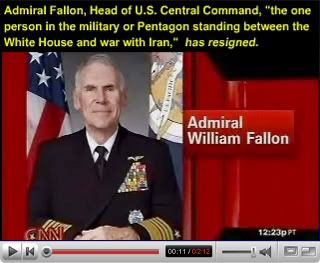
Also see: A Warmongering War President Catapulting the Propaganda and God Help Us All If We Don't Impeach Him Fast
SEE VIDEO: Why Fallon's Resignation is Frightening
See Video:
Also see: A Warmongering War President Catapulting the Propaganda and God Help Us All If We Don't Impeach Him Fast
Dennis Kucinich and Ron Paul are the only two in the U.S. House of Representatives who voted against the horrible war propaganda resolution, H CON RES 21.
"I object to resolutions that lay the groundwork for an offensive, unprovoked war. The resolution passed by the House today sets a dangerous precedent in foreign affairs. A mistranslation could become a cause of war. The United States House may unwittingly be setting the stage for a war with Iran." - Dennis Kucinich (D)
"I rise in strong opposition to this resolution. This resolution is an exercise in propaganda that serves one purpose: to move us closer to initiating a war against Iran." - Ron Paul (R)
Also see: The Public Campaign to Stop the Lies and the Denial of the Main Motive for the 9/11 Attacks: U.S. Support for IsraelWednesday, July 11, 2007
Most Subscribed : Gurus : (All Time) RepresentativePress?
Most Subscribed : Gurus : (All Time) RepresentativePress?
Tuesday, July 10, 2007
Who would do the best job fixing the Nation's Health Care System?
Ask Michael Moore to start backing the Presidential Candidate who would do the best job fixing the Nation's Health Care System: Dennis Kucinich!
Ask Michael Moore to start backing the Presidential Candidate who would do the best job fixing the Nation's Health Care System: Dennis Kucinich!
Monday, July 09, 2007
Israel Violates UN Security Council by Occupying Syrian Golan Heights
Israel has been flatly refusing any negotiations.
NOAM CHOMSKY: Israel is in control of, in fact, has annexed - in violation of Security Council orders - has annexed a large part of Syrian territory, the Golan Heights. Syria is making it very clear that they are interested in a peace settlement with Israel, which would involve, as it should, the withdrawal of Israeli troops from occupied territories.
AMY GOODMAN: Are there secret negotiations going on between Israel and Syria now?
NOAM CHOMSKY: You never know what's going on in secret, but so far Israel has been flatly refusing any negotiations. In fact, the only debate that's going on now is whether it's the United States that's pressuring Israel or Israel's pressuring the United States to prevent negotiations on the Golan Heights and, in fact, on the Occupied Territories altogether.
I mean, this is called a very contentious issue, Israel-Palestine, which is kind of surprising. It's a contentious issue only in the United States, and even not among the American population. It's a contentious issue because the US government and the Israeli government are blocking a very broad international consensus, which has almost universal support, even the majority of Americans, and which has been on the table for about thirty years, blocked by the US and Israel.
Amy Goodman Noam Chomsky 4/16/07 Democracy Now!
Israel has been flatly refusing any negotiations.
NOAM CHOMSKY: Israel is in control of, in fact, has annexed - in violation of Security Council orders - has annexed a large part of Syrian territory, the Golan Heights. Syria is making it very clear that they are interested in a peace settlement with Israel, which would involve, as it should, the withdrawal of Israeli troops from occupied territories.
AMY GOODMAN: Are there secret negotiations going on between Israel and Syria now?
NOAM CHOMSKY: You never know what's going on in secret, but so far Israel has been flatly refusing any negotiations. In fact, the only debate that's going on now is whether it's the United States that's pressuring Israel or Israel's pressuring the United States to prevent negotiations on the Golan Heights and, in fact, on the Occupied Territories altogether.
I mean, this is called a very contentious issue, Israel-Palestine, which is kind of surprising. It's a contentious issue only in the United States, and even not among the American population. It's a contentious issue because the US government and the Israeli government are blocking a very broad international consensus, which has almost universal support, even the majority of Americans, and which has been on the table for about thirty years, blocked by the US and Israel.
Amy Goodman Noam Chomsky 4/16/07 Democracy Now!
Monday, July 02, 2007
Sunday, July 01, 2007
Israel Chooses Expansion and Oppression over Security
Israel Chooses Expansion and Oppression over Security
"Well, I've felt for many years, and have written incidentally, that the people who call themselves supporters of Israel are in reality supporters of Israel's moral degeneration and probably ultimate destruction. I mean, Israel can have security. In fact, that's been true for over 30 years. It has chosen instead expansion at the cost of security.
I agree with my Israeli friends who think that the policies they are taking are extremely self-des - first of all WRONG but also self-destructive and that if they do pursue security and peace instead of expansion and oppression their prospects are very much improved." - Noam Chomsky
The Fateful Triangle: The United States, Israel and the Palestinians
Interventions
Perilous Power: The Middle East & U.S. Foreign Policy: Dialogues on Terror, Democracy, War, and Justice
"Well, I've felt for many years, and have written incidentally, that the people who call themselves supporters of Israel are in reality supporters of Israel's moral degeneration and probably ultimate destruction. I mean, Israel can have security. In fact, that's been true for over 30 years. It has chosen instead expansion at the cost of security.
I agree with my Israeli friends who think that the policies they are taking are extremely self-des - first of all WRONG but also self-destructive and that if they do pursue security and peace instead of expansion and oppression their prospects are very much improved." - Noam Chomsky
The Fateful Triangle: The United States, Israel and the Palestinians
Interventions
Perilous Power: The Middle East & U.S. Foreign Policy: Dialogues on Terror, Democracy, War, and Justice
Subscribe to:
Posts (Atom)


 Posts
Posts


